The spare spool
Mina had tested her kite in the garden all week. At the park, she reached into her bag and found the kite but no spool of string. Across the grass, Leo was packing away a kite with a torn wing. Mina almost asked to borrow his string. Last week, however, she had refused to lend him her coloured pencils.
She walked over anyway. “I wasn't very helpful last week,” she said. “I'm sorry. Could I borrow your spool?”
Leo studied his broken kite, then handed it over. “Only if I can help launch yours.”
Soon they were both looking up. Mina held the spool for a while, then placed it in Leo's hand.
Which summary includes the main problem and its resolution?
Mina lacks string, apologises to Leo and shares a kite flight with him.
Mina practises in her garden before taking a bag to the park.
Two children argue about pencils and leave the park.
Leo tears a kite and asks Mina to buy a new one.
VC2E4LY09
Question 7
locating details · support
Testing the shade cloth
Our class wanted to find out whether a shade cloth helped the soil stay damp. We filled two identical trays with the same amount of soil and water. We put them side by side outside. One tray was covered by shade cloth; the other was uncovered. We checked both trays at three o'clock each afternoon.
Monday: covered soil damp; uncovered soil damp.
Tuesday: covered soil damp; uncovered soil slightly damp.
Wednesday: covered soil slightly damp; uncovered soil dry.
We concluded that, in our three-day trial, the covered soil stayed damp longer. We want to repeat the trial in different weather before making a general claim.
What was deliberately different between the two trays?
Make a seed label
You need a clean, dry ice-cream stick, a pencil and a waterproof pen. Ask an adult to check that the stick has no splinters.
1. Write the plant's name lightly in pencil near the top of the stick.
2. Check the spelling against the seed packet. Correct any mistakes now.
3. Trace over the name with waterproof pen.
4. Wait until the ink is dry, then push the blank end into the soil beside the seeds.
If you are labelling several rows, finish one label before beginning the next. This helps you match each label to the correct packet. Keep the writing above the soil so that it remains easy to read.
A quieter lunchtime choice
Dear Student Council,
Please turn the unused corner beside the library into a quiet lunchtime space. Students who enjoy reading or drawing sometimes struggle to find a calm place in the busy playground. Two benches and a box of drawing boards would give them somewhere to settle.
Some students worry that a quiet space will take away a place to run. However, the corner is already too narrow for running games. The large oval would remain open for active play.
Could we try the quiet space for two weeks and ask students whether it helps? A trial would let us improve the idea before spending money on more equipment.
Yours sincerely,
Amir, Year 4
Which statement best describes the letter's structure?
Equipment list followed by numbered steps.
Request, reasons, response to an objection, proposed trial.
Alphabetical definitions followed by a quiz.
Characters, magical problem, surprise ending.
VC2E4LA03 · VC2E4LY08
Question 25
tracking a change · core
Tuesday's rehearsal
I thought I knew every line of our play. At rehearsal, I spoke before Jo had finished, skipped a whole sentence and forgot to turn towards the audience. Our teacher asked us to try the scene again, more slowly.
This time I listened for Jo's final word. I took a breath before answering. The pause felt enormous to me, but our teacher said it helped the audience understand the change of speaker.
At home I was going to practise the speech ten times without stopping. Now I have a different plan: Mum will read Jo's part, and I will practise listening as well as speaking. Knowing my own lines is only part of the job.
Which feature makes this text a personal reflection?
It reports only other people's opinions.
It provides ticket prices and booking times.
It defines every theatre term alphabetically.
It explains what the writer learned from an experience.
VC2E4LA03 · VC2E4LY08
Question 31
comparing information · core
The Saturday repair table
A table outside the community hall used to display things for sale. Now volunteers use it to mend small items. A sign says: “Bring one broken item. We will see whether it can be repaired.” There is no promise that everything can be fixed.
Last Saturday a volunteer replaced a missing wheel on a toy truck. Another sewed a button onto a coat. A cracked glass vase was set aside because no one had the right materials to repair it safely.
Visitors watch the repairs and ask questions. “I thought I needed a new bag,” said one visitor, “but I only needed someone to show me how to mend the strap.” The organisers say the table saves useful objects and helps neighbours share skills.
How has the table's use changed?
It is now used only to display vases.
It is used for selling new coats instead of repairs.
It is used for repairs instead of displaying sale items.
They give a specific example of how the table helped someone.
They explain how to replace a truck wheel step by step.
They provide the hall's opening hours.
They prove every damaged item can be repaired.
VC2E4LY09
Question 37
distinguishing information · core
Subject: Changes to Friday's garden visit
Hello Year 4,
Our visit to the community garden will still take place on Friday. However, we will leave school at 10:00 am instead of 9:30 am because the gardener has a morning delivery.
Bring a hat, a water bottle and a packed lunch. You will not need a gardening tool; the garden will supply tools for our activity. Wear closed shoes.
If heavy rain is forecast on Thursday afternoon, we will send another message to families and hold the planting activity in our classroom instead. Please do not assume the visit is cancelled just because it is cloudy.
We expect to return to school by 1:30 pm.
Ms Tran
Which conclusion is justified before another message arrives?
Every student must bring a shovel.
The visit is planned to go ahead with a later departure.
The visit is certainly cancelled.
Families should collect children at the garden at 10 am.
VC2E4LA04 · VC2E4LY09
Question 43
literal information · support
An observation, not a race
During a class observation, six garden snails were placed on a damp mat beside a shelter. The children watched quietly for ten minutes. Four snails moved under the shelter. Two stayed on the mat. The class did not know whether those two moved later because the observation had ended.
A student wrote, “Most of our six snails moved under the shelter during the observation.” Another wrote, “All snails always choose shelter.”
Their teacher asked them to compare the claims. A small observation tells us about what happened in that place and time. It cannot show what every snail will do. The children returned the snails to the garden where they had found them.
Which question would need a new observation to answer?
How long did the children watch?
What did the two snails do after ten minutes?
How many snails were watched?
Where were the snails returned?
VC2E4LY09
Question 49
combining clues · core
After the shower
A gutter gurgles, full of sky;
A silver bead slips slowly by.
My boots make islands in the lane,
Then small round worlds of mud again.
The clouds unzip a strip of blue.
A sparrow shakes; the rain is through.
Why would rereading the final two lines help a confused reader?
They confirm that the shower is ending.
They reveal the speaker's exact age.
They explain how gutters are built.
They list everything inside the boots.
VC2E4LY09
Question 55
comparing agreement · core
Two reviews of the fictional game Trail Builders
Review A — Ella: The map is clear, and the short rounds fit our lunch break. I like having a choice of routes. However, the tiny counters are easily lost. I would recommend this game for a quick challenge if you have a tray to hold the pieces.
Review B — Noah: We understood the map immediately. The choice of routes makes each round different, but the rounds finish just when I am enjoying myself. I would prefer a longer game. The counters are too small to handle comfortably.
Both reviewers played the same edition. These are their own opinions, not the manufacturer's description.
Which feature do both reviewers describe positively?
What explains why the same feature receives different judgements?
One reviewer is describing a different edition.
The reviewers want different lengths of play.
The counters change size between reviews.
One reviewer has never seen the map.
VC2E4LY09
Question 61
purpose across time · core
Two children's story openings from different times
A — The Tale of Peter Rabbit by Beatrix Potter, first published in 1902. This is its opening sentence, with line breaks preserved:
“Once upon a time there were four little Rabbits, and their names were—
Flopsy,
Mopsy,
Cotton-tail,
and Peter.”
B — Pip's Morning, an original Pileo Academy classroom story, 2026:
Meet Pip: a rabbit with muddy paws and a plan. This morning she is going to find out who has been nibbling the carrot tops. Her brothers think the answer is obvious. Pip is not so sure.
Both openings introduce rabbit characters in stories for children. The short extracts do not show the complete stories.
Museum website mock-up
PAGE TITLE: River Town Museum
TOP MENU: Visit | Collections | Learn | Contact
Visit drop-down: Opening hours | Tickets | Getting here
BREADCRUMB: Home > Learn > School workshops
HEADING: Build a bridge workshop
The workshop is for school groups in Years 3–6. Bookings are essential.
UNDERLINED LINK: Download the teacher planning sheet
BUTTON: Book a school workshop
IMAGE CAPTION: Students test a model bridge with small weights.
FOOTER: Accessibility | Site map
This is a fictional page layout for reading practice. Its labels are not live links.
Which menu path would help you find how to travel to the museum?
Compare the dated story openings using one similarity of purpose and two differences in language or presentation. Explain why the dates do not prove that every story of each period uses the same style.
What to aim for
Names the common purpose and audience.
Gives two supported differences.
Avoids generalising two extracts to all writing in either period.
Suggest two headings that would help a reader find the method and the results. State which sentences belong under each heading.
What to aim for
Provides clear headings.
Matches each heading to relevant information.
Preserves the distinction between procedure and observations.
Response or adult observation notes:
VC2E4LY09
Question 96
moving images and sound · extension
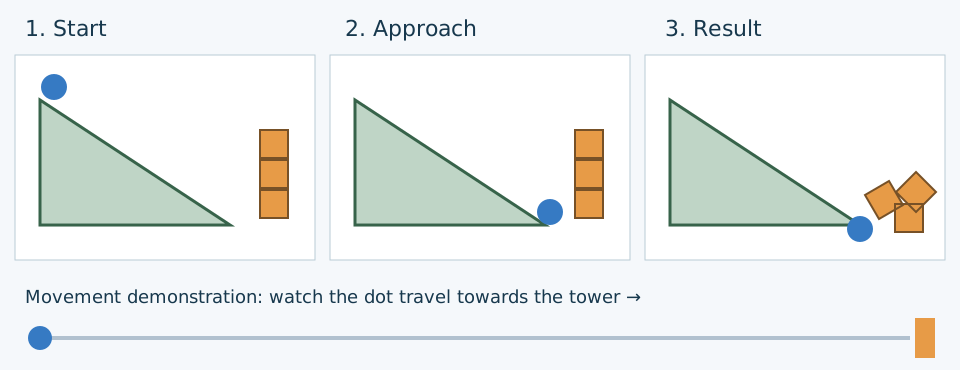
Use the three numbered panels; the dot moves once for five seconds, with a static fallback for reduced motion. You can trace the sequence with a finger at any time. For sound tasks, an adult or partner supplies the specified quiet taps/clap at a comfortable volume; no recording is required.
Original moving-image study: a ball rolls towards a block tower. The three panels show the start, approach and result.
On paper: follow the numbered panels and trace the ball’s path with your finger. For sound comparisons, the adult supplies the sounds while you trace the same path.
Watch the dot make one five-second movement, or follow the three panels if reduced motion is enabled. Explain how position changes show the sequence without needing a paragraph of narration.
What to aim for
Refers to at least two panels.
Explains movement or position.
Connects the sequence to the event.
Response or adult observation notes:
VC2E4LA09 · VC2E4LY09
Question 97
moving images and sound · extension
Use the three numbered panels; the dot moves once for five seconds, with a static fallback for reduced motion. You can trace the sequence with a finger at any time. For sound tasks, an adult or partner supplies the specified quiet taps/clap at a comfortable volume; no recording is required.
On paper: follow the numbered panels and trace the ball’s path with your finger. For sound comparisons, the adult supplies the sounds while you trace the same path.
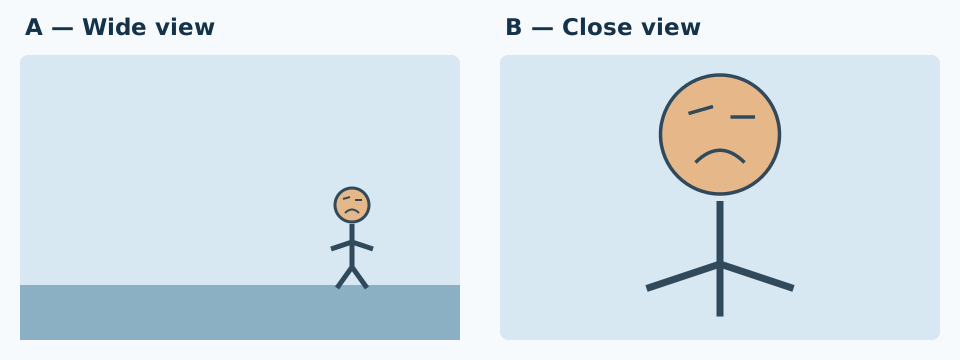
A film could begin with a close view of the ball or a wide view of the whole ramp and tower. Explain what each opening would reveal and which you would choose to help a new viewer understand the setup.
What to aim for
Compares both framing choices.
Explains information included or excluded.
Justifies a choice for the audience.
Response or adult observation notes:
VC2E4LA09 · VC2E4LY09
Question 98
moving images and sound · extension
Use the three numbered panels; the dot moves once for five seconds, with a static fallback for reduced motion. You can trace the sequence with a finger at any time. For sound tasks, an adult or partner supplies the specified quiet taps/clap at a comfortable volume; no recording is required.
On paper: follow the numbered panels and trace the ball’s path with your finger. For sound comparisons, the adult supplies the sounds while you trace the same path.
Ask an adult to tap slowly while pointing to panel 1, then tap faster while following the moving dot towards the tower. Watch once with these sounds and once silently. Describe how sound changes your expectation.
What to aim for
Experiences both a silent and sounded version.
Names a change in the sound.
Explains a supported effect on the viewer.
Response or adult observation notes:
VC2E4LA09 · VC2E4LY09
Question 99
moving images and sound · extension
Use the three numbered panels; the dot moves once for five seconds, with a static fallback for reduced motion. You can trace the sequence with a finger at any time. For sound tasks, an adult or partner supplies the specified quiet taps/clap at a comfortable volume; no recording is required.
On paper: follow the numbered panels and trace the ball’s path with your finger. For sound comparisons, the adult supplies the sounds while you trace the same path.
Make two sound versions of panel 3: one soft tap and one sudden louder clap. Keep the drawing the same. Explain how the two versions change the apparent size or force of the event.
What to aim for
Compares two actual sound versions.
Keeps the image constant.
Connects loudness to an interpretation without calling it proof.
Response or adult observation notes:
VC2E4LA09 · VC2E4LY09
Question 100
moving images and sound · extension
Use the three numbered panels; the dot moves once for five seconds, with a static fallback for reduced motion. You can trace the sequence with a finger at any time. For sound tasks, an adult or partner supplies the specified quiet taps/clap at a comfortable volume; no recording is required.
On paper: follow the numbered panels and trace the ball’s path with your finger. For sound comparisons, the adult supplies the sounds while you trace the same path.
Imagine enlarging only the tower in panel 2 and making the other elements pale. Explain how that would change the viewer's attention before the fall.