Question 1
visual composition · core
Compare the two original images. An accessible description is provided with the image.
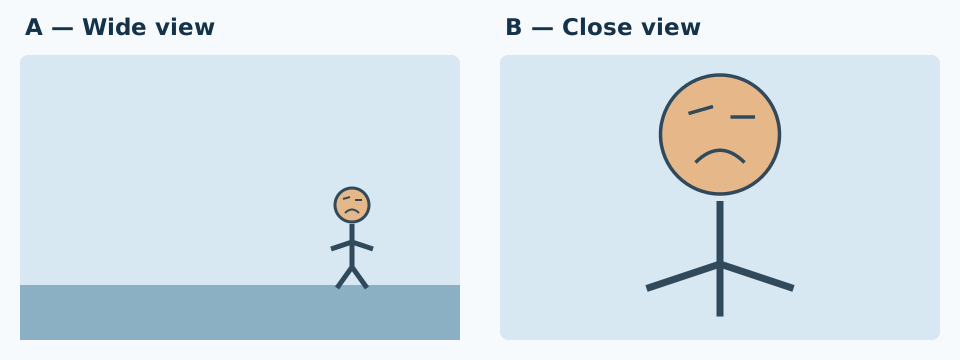
Which view makes the character's facial expression easier to examine?
VC2E4LA09 · VC2E4LY09
Pi Leo Academy · Year 4 English
13 questions and practical tasks · Victorian Curriculum English Version 2.0 · Level 4 · VC2E4LA09
Questions with a separate answer key and review guidance.
Circle one option for multiple-choice questions. Use the response spaces or extra paper for longer work.
Name: ________________________________ Date: __________________
visual composition · core
Which view makes the character's facial expression easier to examine?
VC2E4LA09 · VC2E4LY09
visual composition · core
What does the wide view help the viewer notice?
VC2E4LA09 · VC2E4LY09
visual composition · core
Which statement is an interpretation supported by View A?
VC2E4LA09 · VC2E4LY09
visual composition · core
What changes between the two views?
VC2E4LA09 · VC2E4LY09
visual composition · core
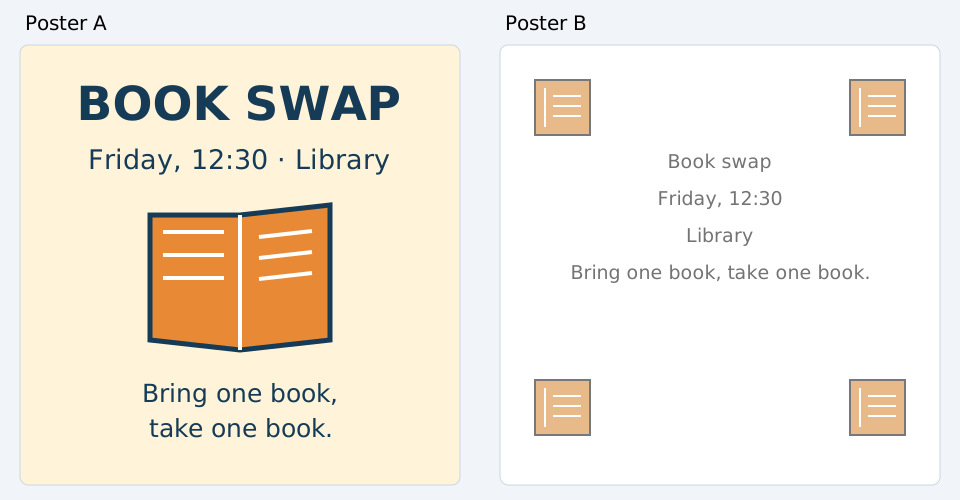
Which feature of Poster A makes the event name noticeable first?
VC2E4LA09 · VC2E4LY09
visual composition · core
Why might Poster A be easier to read quickly from a distance?
VC2E4LA09 · VC2E4LY09
visual composition · core
What job does the large book illustration do in Poster A?
VC2E4LA09 · VC2E4LY09
visual composition · core
Which judgement compares the posters using visual evidence?
VC2E4LA09 · VC2E4LY09
moving images and sound · extension
Use the three numbered panels; the dot moves once for five seconds, with a static fallback for reduced motion. You can trace the sequence with a finger at any time. For sound tasks, an adult or partner supplies the specified quiet taps/clap at a comfortable volume; no recording is required.
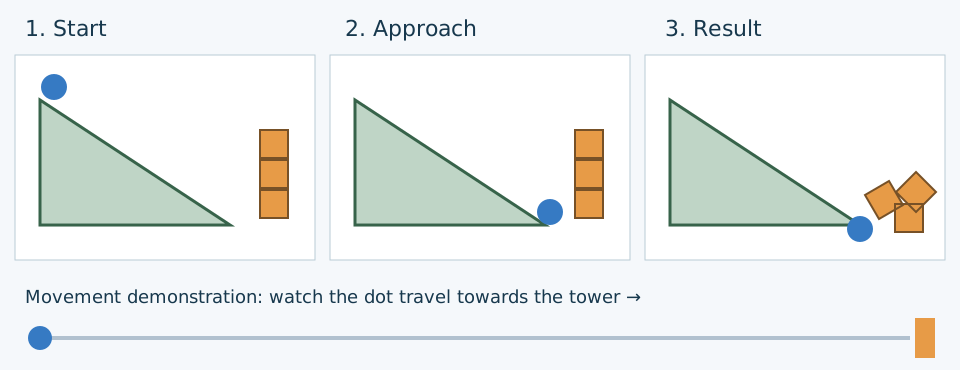
On paper: follow the numbered panels and trace the ball’s path with your finger. For sound comparisons, the adult supplies the sounds while you trace the same path.
Watch the dot make one five-second movement, or follow the three panels if reduced motion is enabled. Explain how position changes show the sequence without needing a paragraph of narration.
Response or adult observation notes:
VC2E4LA09 · VC2E4LY09
moving images and sound · extension
Use the three numbered panels; the dot moves once for five seconds, with a static fallback for reduced motion. You can trace the sequence with a finger at any time. For sound tasks, an adult or partner supplies the specified quiet taps/clap at a comfortable volume; no recording is required.
On paper: follow the numbered panels and trace the ball’s path with your finger. For sound comparisons, the adult supplies the sounds while you trace the same path.
A film could begin with a close view of the ball or a wide view of the whole ramp and tower. Explain what each opening would reveal and which you would choose to help a new viewer understand the setup.
Response or adult observation notes:
VC2E4LA09 · VC2E4LY09
moving images and sound · extension
Use the three numbered panels; the dot moves once for five seconds, with a static fallback for reduced motion. You can trace the sequence with a finger at any time. For sound tasks, an adult or partner supplies the specified quiet taps/clap at a comfortable volume; no recording is required.
On paper: follow the numbered panels and trace the ball’s path with your finger. For sound comparisons, the adult supplies the sounds while you trace the same path.
Ask an adult to tap slowly while pointing to panel 1, then tap faster while following the moving dot towards the tower. Watch once with these sounds and once silently. Describe how sound changes your expectation.
Response or adult observation notes:
VC2E4LA09 · VC2E4LY09
moving images and sound · extension
Use the three numbered panels; the dot moves once for five seconds, with a static fallback for reduced motion. You can trace the sequence with a finger at any time. For sound tasks, an adult or partner supplies the specified quiet taps/clap at a comfortable volume; no recording is required.
On paper: follow the numbered panels and trace the ball’s path with your finger. For sound comparisons, the adult supplies the sounds while you trace the same path.
Make two sound versions of panel 3: one soft tap and one sudden louder clap. Keep the drawing the same. Explain how the two versions change the apparent size or force of the event.
Response or adult observation notes:
VC2E4LA09 · VC2E4LY09
moving images and sound · extension
Use the three numbered panels; the dot moves once for five seconds, with a static fallback for reduced motion. You can trace the sequence with a finger at any time. For sound tasks, an adult or partner supplies the specified quiet taps/clap at a comfortable volume; no recording is required.
On paper: follow the numbered panels and trace the ball’s path with your finger. For sound comparisons, the adult supplies the sounds while you trace the same path.
Imagine enlarging only the tower in panel 2 and making the other elements pale. Explain how that would change the viewer's attention before the fall.
Response or adult observation notes:
VC2E4LA09 · VC2E4LY09
Open responses, handwriting and spoken tasks need adult review. The models are examples; different responses may meet the criteria.
Answer: View B, because the face occupies more of the frame.
The close framing enlarges the eyebrow and mouth, directing attention to expression.
Answer: How small the figure is compared with the empty stage.
View A includes much more empty space around the same figure.
Answer: The empty space may make the figure seem alone.
Composition can suggest a mood; the picture does not establish the character's entire life or next action.
Answer: The framing and amount of surrounding space.
The same figure is shown at different scales; no extra people or spoken text appear.
Answer: The large dark heading at the top.
Size, darkness and high placement give the heading visual prominence.
Answer: Its text sizes separate the event name from the details.
The hierarchy lets readers find the event name, then time and place; the wording is otherwise the same.
Answer: It reinforces that the event is about books.
The image supports the written topic but cannot supply unstated details.
Answer: A has one strong centre of attention; B spreads attention across similar elements.
A's large central book contrasts with B's repeated small books and uniform type.
Example response / review guidance: The ball begins high on the ramp, moves towards the blocks and is followed by the fallen tower. The positions and panel numbers make the order visible.
Visual framing, placement, movement and sound work together to shape meaning. Give a reason linked to an observed feature; different supported interpretations are welcome.
Example response / review guidance: A close view draws attention to the ball but hides its destination. A wide view reveals the ramp and tower together, so I would start wide to explain the setup.
Visual framing, placement, movement and sound work together to shape meaning. Give a reason linked to an observed feature; different supported interpretations are welcome.
Example response / review guidance: The increasing tapping makes the approach feel quicker or more suspenseful. Without it, I rely on the positions and movement. Sound changes the feeling, not the basic sequence.
Visual framing, placement, movement and sound work together to shape meaning. Give a reason linked to an observed feature; different supported interpretations are welcome.
Example response / review guidance: A soft tap can make the fall seem small and gentle; a sudden clap can make it seem forceful or surprising, although the picture is unchanged.
Visual framing, placement, movement and sound work together to shape meaning. Give a reason linked to an observed feature; different supported interpretations are welcome.
Example response / review guidance: The large, darker tower would become the most noticeable element. Viewers might anticipate what will happen to it as the ball approaches.
Visual framing, placement, movement and sound work together to shape meaning. Give a reason linked to an observed feature; different supported interpretations are welcome.