
Mathematics classroom notes
Year 2 - Measure length in centimetres and metres
Strand / topic: Measurement and Geometry / Measure length in centimetres and metres
Based on Pi Leo Academy's Victorian Curriculum F-10 Mathematics year-level guide and aligned to NAPLAN-style mathematical reasoning. Official curriculum code: Not stated in the provided curriculum source.
By the end of this note, students should be able to explain measure length in centimetres and metres, use a clear method, solve simple and test-style questions, and check their answers for Year 2 Measurement and Geometry work.
It helps with cooking, sport, building, travel, science and everyday estimating. This topic builds the reasoning, fluency and confidence students need for future NAPLAN-style questions and everyday mathematics.
What am I measuring?
Choose the thing first: length, distance, mass, capacity or temperature.
A drink bottle is measured in millilitres or litres, but a classroom temperature is measured in degrees Celsius.
For Year 2, focus on understanding the idea before rushing to the final answer.
Think about it: weather, cooking, sport, maps and shopping all need sensible measurements.
Concept example. The story examples below have their own diagrams.
Choose the attribute first: length, mass, capacity, temperature or distance.
What you need to know for this topic
Use this as a study checklist before trying quizzes, worksheets or NAPLAN-style questions.
Key ideas taught here
- Name what is being measured before choosing a unit or tool. Review: What this means
- Use degrees Celsius for temperature, a ruler for length, scales for mass and a jug for capacity. Review: What this means
- Estimate first so the final answer can be checked for reasonableness. Review: What this means
- When using a map scale, multiply the map distance by the scale value. Review: What this means
Method and checking
- Decide what is being measured: length, mass, capacity, temperature or distance. Review: Step-by-step method
- Choose a sensible metric unit and tool. Review: Step-by-step method
- Read the scale from zero or from the correct starting mark. Review: Step-by-step method
- Compare, convert or calculate, then check the unit is sensible. Review: Step-by-step method
1 What this means
Measurement helps us describe size, distance, mass, capacity and temperature using sensible metric units. Start by learning to choose a sensible unit and compare or calculate using the same unit throughout. A helpful visual is a labelled ruler, scale or measuring container. For example, this idea can be used when choosing units for cooking, sport or building. Use objects or drawings before moving to number sentences.
Measurement questions become easier when students first decide what attribute is being measured: length, distance, mass, capacity or temperature. In Year 2, students should first ask, 'What is the question really asking me to find?' Then they can draw a picture, make a table, use a number line, write a formula or build an equation. The final answer should match the story, the units and the size of the numbers.
- Name what is being measured before choosing a unit or tool.
- Use degrees Celsius for temperature, a ruler for length, scales for mass and a jug for capacity.
- Estimate first so the final answer can be checked for reasonableness.
- When using a map scale, multiply the map distance by the scale value.
2 Important rules / ideas
Length, mass, capacity, temperature and distance use different tools and units.
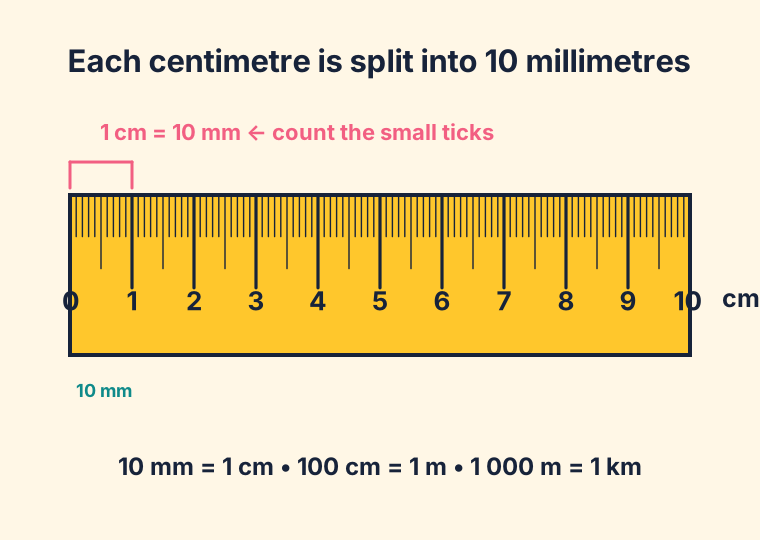
Use mm, cm, m and km for length; g and kg for mass; mL and L for capacity; °C for temperature.
Check what each tick mark represents before reading a ruler, thermometer, jug, scale or map.
Important vocabulary
How long, wide or tall something is.
How heavy something is.
How much a container can hold.
A set of marks that shows measured values, such as on a ruler, thermometer or map.
3 Step-by-step method
- Decide what is being measured: length, mass, capacity, temperature or distance.
- Choose a sensible metric unit and tool.
- Read the scale from zero or from the correct starting mark.
- Compare, convert or calculate, then check the unit is sensible.
4 Worked examples
A pencil starts at 0 cm and ends at 8 cm on a ruler. How long is it?
- When the object starts at 0 cm, read the ending mark.
- The pencil ends at 8 cm.
- The pencil is 8 cm long.
An eraser starts at 2 cm and ends at 7 cm. How long is it?
- Subtract the starting mark from the ending mark.
- 7 cm - 2 cm = 5 cm.
- The eraser is 5 cm long.
A ribbon starts at 3 cm and ends at 16 cm. How long is it?
- Use ending mark minus starting mark.
- 16 cm - 3 cm = 13 cm.
- The ribbon is 13 cm long.
A craft strip is 11 cm long. Mia cuts off 4 cm. How much is left?
- Subtract the cut-off length.
- 11 cm - 4 cm = 7 cm.
- There are 7 cm left.
5 More examples
The liquid is halfway between 20°C and 30°C.
Halfway between 20 and 30 is 25, so the temperature is 25°C.
Which unit suits a swimming pool: mL or L?
A swimming pool holds a large amount of water, so litres or kilolitres are more sensible than millilitres.
NAPLAN-style thinking
In NAPLAN-style questions, measure length in centimetres and metres may appear as a short calculation, a word problem, a diagram, a table or a multi-step reasoning question. Students should slow down and decide what the question is really asking before calculating.
Estimate first and eliminate answers that are too small, too large or use the wrong unit.
Write only the answer required, but use working on paper to avoid mental slips.
Circle the numbers, underline the action words and decide whether all numbers are needed.
Do one step at a time and label intermediate answers so the final step is clear.
6 Common mistakes
Match the unit to the thing: cm for a pencil, kg for a school bag and °C for temperature.
On a ruler, subtract the starting mark if the object does not begin at 0 cm.
Map distance must be multiplied by the scale to find real distance.
- Choosing the first operation seen in the wording.
- Forgetting units, labels or place value.
- Stopping after the first step when the question asks for a final comparison.
7 Tips to remember
Tiny amounts need small units; big distances need bigger units.
Check whether each tick mark is worth 1, 2, 5 or 10 units.
Map distance and real distance are different. Use the scale to connect them.
Parent teaching tips
- Ask your child to explain the method aloud before writing the answer.
- Use a real-life context at home, such as shopping, cooking, sport scores, maps or timetables.
- Praise clear working and checking, not only speed.
- Use counters, blocks, drawings and everyday objects before moving to written symbols.
Remember
Choose the right tool and unit before measuring, then read the scale carefully.
8 Quick practice
- A pencil starts at 0 cm and ends at 8 cm on a ruler. How long is it?
- An eraser starts at 2 cm and ends at 7 cm. How long is it?
- A ribbon starts at 3 cm and ends at 16 cm. How long is it?
- A craft strip is 11 cm long. Mia cuts off 4 cm. How much is left?
9 Answers / explanation
Question 1
Answer: The pencil is 8 cm long.
When the object starts at 0 cm, read the ending mark. The pencil ends at 8 cm. The pencil is 8 cm long.
Question 2
Answer: The eraser is 5 cm long.
Subtract the starting mark from the ending mark. 7 cm - 2 cm = 5 cm. The eraser is 5 cm long.
Question 3
Answer: The ribbon is 13 cm long.
Use ending mark minus starting mark. 16 cm - 3 cm = 13 cm. The ribbon is 13 cm long.
Question 4
Answer: There are 7 cm left.
Subtract the cut-off length. 11 cm - 4 cm = 7 cm. There are 7 cm left.
Extension challenge
Create your own multi-step question for this topic using an Australian context, then solve it and explain each step.
Hint: Use shopping, sport, maps, timetables, weather, school events or measurement at home.
Answer guide
Answers will vary. A strong answer includes clear working, correct units and a final sentence.
Quick revision
- Know what measure length in centimetres and metres is asking you to find.
- Choose a diagram, table, formula, number line or equation before calculating.
- Show enough working that you can find and fix mistakes.
- Check the final answer, units and reasonableness.