
Mathematics classroom notes
Year 8 - Scientific notation
Strand / topic: Number and Algebra / Scientific notation
Based on Pi Leo Academy's Victorian Curriculum F-10 Mathematics year-level guide and aligned to NAPLAN-style mathematical reasoning. Official curriculum code: Not stated in the provided curriculum source.
By the end of this note, students should be able to explain scientific notation, use a clear method, solve simple and test-style questions, and check their answers for Year 8 Number and Algebra work.
It builds number sense, reasoning and confidence for classwork, quizzes and problem solving. This topic builds the reasoning, fluency and confidence students need for future NAPLAN-style questions and everyday mathematics.
How many repeated factors?
An index tells how many times to use the base as a factor.
2 to the power of 4 means 2 x 2 x 2 x 2.
For Year 8, focus on understanding the idea before rushing to the final answer.
Think about it: doubling patterns and scientific notation use powers.
Use this visual to organise scientific notation before calculating.
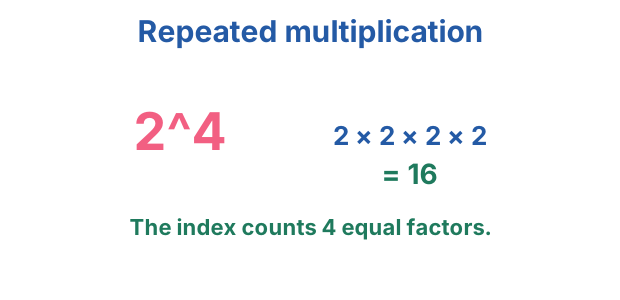
The index counts factors, not zeros.
What you need to know for this topic
Use this as a study checklist before trying quizzes, worksheets or NAPLAN-style questions.
Powers
- base and index
- repeated multiplication
- squares and cubes
- index laws when the base is the same
Notation
- scientific notation
- zero index
- negative powers where appropriate
- estimate large and small numbers
1 What this means
Index notation is a short way to show repeated multiplication. Start by learning to write the power as repeated multiplication before applying index laws. A helpful visual is a multiplication expansion under the power. For example, this idea can be used when solving a practical or unfamiliar problem about scientific notation.
Indices are a compact way to show repeated multiplication. In Year 8, students should first ask, 'What is the question really asking me to find?' Then they can draw a picture, make a table, use a number line, write a formula or build an equation. The final answer should match the story, the units and the size of the numbers.
- Identify the base and index before applying any law.
- Index laws only combine terms in particular conditions, such as the same base.
- Scientific notation uses a number from 1 up to, but not including, 10.
- Check whether the result should become larger or smaller.
2 Important rules / ideas
A power tells how many times the base is used as a factor.
Only use index laws when their conditions are met.
For a non-zero base, any number to the power of 0 equals 1.
Important vocabulary
The number being repeatedly multiplied.
The small raised number showing how many factors.
Another name for index notation.
A compact way to write very large or very small numbers.
3 Step-by-step method
- Identify the base and index.
- Apply the correct index law.
- Simplify step by step.
- Check whether the answer should be large, small or fractional.
4 Worked examples
Write 2 x 2 x 2 x 2 using index notation.
- There are four factors of 2.
- Write 2 to the power of 4.
Simplify 3 squared x 3 cubed.
- Same base, so add indices.
- 2 + 3 = 5.
- Answer: 3 to the power of 5.
Write 4 500 000 in scientific notation.
- Move the decimal point after the first non-zero digit.
- 4.5 x 10 to the power of 6.
A bacteria count doubles each hour. If it starts at 100, write the amount after 3 hours.
- Doubling 3 times means multiply by 2 cubed.
- 100 x 2 cubed = 800.
5 More examples
5 cubed
5 x 5 x 5 = 125.
2 squared x 2 to the power of 4.
Add indices: 2 to the power of 6.
NAPLAN-style thinking
In NAPLAN-style questions, scientific notation may appear as a short calculation, a word problem, a diagram, a table or a multi-step reasoning question. Students should slow down and decide what the question is really asking before calculating.
Estimate first and eliminate answers that are too small, too large or use the wrong unit.
Write only the answer required, but use working on paper to avoid mental slips.
Circle the numbers, underline the action words and decide whether all numbers are needed.
Do one step at a time and label intermediate answers so the final step is clear.
6 Common mistakes
Read the final sentence before calculating.
Name the topic and method before starting.
Estimate or use inverse operations to check.
- Choosing the first operation seen in the wording.
- Forgetting units, labels or place value.
- Stopping after the first step when the question asks for a final comparison.
7 Tips to remember
An index counts repeated factors.
Do not combine powers unless the law applies.
Keep the front number from 1 up to, but not including, 10.
Parent teaching tips
- Ask your child to explain the method aloud before writing the answer.
- Use a real-life context at home, such as shopping, cooking, sport scores, maps or timetables.
- Praise clear working and checking, not only speed.
- Ask your child to write the formula or rule first, then substitute values carefully.
Remember
For scientific notation, identify the question type, choose a clear method, show working and check the answer.
8 Quick practice
- Write 2 x 2 x 2 x 2 using index notation.
- Simplify 3 squared x 3 cubed.
- Write 4 500 000 in scientific notation.
- A bacteria count doubles each hour. If it starts at 100, write the amount after 3 hours.
9 Answers / explanation
Question 1
Answer: Write 2 to the power of 4.
There are four factors of 2. Write 2 to the power of 4.
Question 2
Answer: 3 to the power of 5.
Same base, so add indices. 2 + 3 = 5. Answer: 3 to the power of 5.
Question 3
Answer: 4.5 x 10 to the power of 6.
Move the decimal point after the first non-zero digit. 4.5 x 10 to the power of 6.
Question 4
Answer: 100 x 2 cubed = 800.
Doubling 3 times means multiply by 2 cubed. 100 x 2 cubed = 800.
Extension challenge
Create your own multi-step question for this topic using an Australian context, then solve it and explain each step.
Hint: Use shopping, sport, maps, timetables, weather, school events or measurement at home.
Answer guide
Answers will vary. A strong answer includes clear working, correct units and a final sentence.
Quick revision
- Know what scientific notation is asking you to find.
- Choose a diagram, table, formula, number line or equation before calculating.
- Show enough working that you can find and fix mistakes.
- Check the final answer, units and reasonableness.