
Mathematics classroom notes
Year 9 - Solve right-angled triangle problems
Strand / topic: Measurement and Geometry / Solve right-angled triangle problems
Based on Pi Leo Academy's Victorian Curriculum F-10 Mathematics year-level guide and aligned to NAPLAN-style mathematical reasoning. Official curriculum code: Not stated in the provided curriculum source.
By the end of this note, students should be able to explain solve right-angled triangle problems, use a clear method, solve simple and test-style questions, and check their answers for Year 9 Measurement and Geometry work.
It builds number sense, reasoning and confidence for classwork, quizzes and problem solving. This is a NAPLAN year, so students should practise reading the question carefully, choosing the correct operation or formula, showing working and checking whether the answer is reasonable.
How much has it turned?
An angle measures the size of a turn or opening.
A square corner is a right angle, which is 90 degrees.
For Year 9, focus on understanding the idea before rushing to the final answer.
Think about it: doors, ramps, clocks and turns on a map all make angles.
Use this visual to organise solve right-angled triangle problems before calculating.
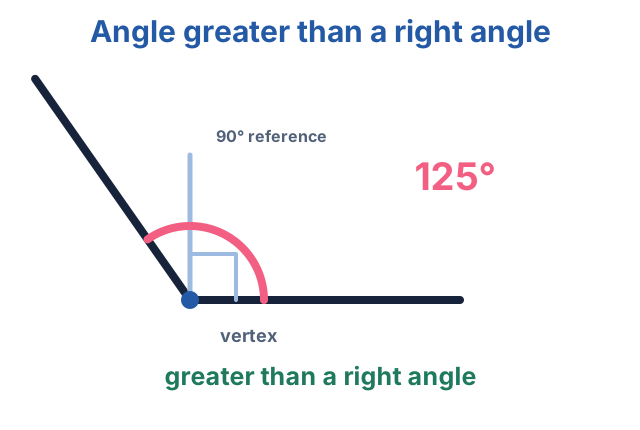
Compare with 90 degrees and 180 degrees before calculating.
What you need to know for this topic
Use this as a study checklist before trying quizzes, worksheets or NAPLAN-style questions.
Line and angle ideas
- line segments, lines and rays
- angles less than a right angle
- right angles
- angles greater than a right angle
Angle names
- acute angles
- right angles
- obtuse angles
- straight angles
Angle reasoning
- estimate angle sizes
- compare to 90 degrees and 180 degrees
- use angle facts in diagrams
1 What this means
An angle shows how much something turns or opens. Start by learning to locate the vertex and compare the opening with a right angle or known angle fact. A helpful visual is a clear ray diagram with the vertex marked. For example, this idea can be used when solving a practical or unfamiliar problem about solve right-angled triangle problems.
Angle questions are about turn, size and relationships, not just about how a diagram looks. In Year 9, students should first ask, 'What is the question really asking me to find?' Then they can draw a picture, make a table, use a number line, write a formula or build an equation. The final answer should match the story, the units and the size of the numbers.
- Compare angles to known benchmarks: right angle, straight angle and full turn.
- Mark known angle facts before calculating missing angles.
- Use the diagram as a guide, but trust the angle relationships.
- Write degrees with the degree symbol or the word degrees.
2 Important rules / ideas
A right angle is 90 degrees.
Angles on a straight line add to 180 degrees.
A full turn is 360 degrees.
Important vocabulary
The amount of turn between two arms.
An angle of 90 degrees.
An angle smaller than 90 degrees.
An angle larger than 90 degrees but smaller than 180 degrees.
3 Step-by-step method
- Look for known angle facts.
- Mark right angles, straight lines or parallel lines.
- Write an equation if needed.
- Check that the angle size is reasonable.
4 Worked examples
Classify an angle of 70 degrees.
- 70 degrees is less than 90 degrees.
- It is an acute angle.
Two angles on a straight line include 115 degrees. Find the other angle.
- Angles on a straight line add to 180 degrees.
- 180 - 115 = 65.
- The other angle is 65 degrees.
A triangle has angles 45 degrees and 65 degrees. Find the third angle.
- Angles in a triangle add to 180 degrees.
- 45 + 65 = 110.
- 180 - 110 = 70 degrees.
A robot turns a right angle, then another right angle. How far has it turned?
- One right angle is 90 degrees.
- 90 + 90 = 180 degrees.
- It has made a half turn.
5 More examples
Is 135 degrees acute, right or obtuse?
It is greater than 90 and less than 180, so it is obtuse.
One angle is 72 degrees on a straight line.
The other angle is 180 - 72 = 108 degrees.
NAPLAN-style thinking
In NAPLAN-style questions, solve right-angled triangle problems may appear as a short calculation, a word problem, a diagram, a table or a multi-step reasoning question. Students should slow down and decide what the question is really asking before calculating.
Estimate first and eliminate answers that are too small, too large or use the wrong unit.
Write only the answer required, but use working on paper to avoid mental slips.
Circle the numbers, underline the action words and decide whether all numbers are needed.
Do one step at a time and label intermediate answers so the final step is clear.
6 Common mistakes
Read the final sentence before calculating.
Name the topic and method before starting.
Estimate or use inverse operations to check.
- Choosing the first operation seen in the wording.
- Forgetting units, labels or place value.
- Stopping after the first step when the question asks for a final comparison.
7 Tips to remember
Compare to 90, 180 and 360 degrees.
Some diagrams are not drawn exactly to scale.
Write the fact before calculating.
Parent teaching tips
- Ask your child to explain the method aloud before writing the answer.
- Use a real-life context at home, such as shopping, cooking, sport scores, maps or timetables.
- Praise clear working and checking, not only speed.
- Ask your child to write the formula or rule first, then substitute values carefully.
Remember
For solve right-angled triangle problems, identify the question type, choose a clear method, show working and check the answer.
8 Quick practice
- Classify an angle of 70 degrees.
- Two angles on a straight line include 115 degrees. Find the other angle.
- A triangle has angles 45 degrees and 65 degrees. Find the third angle.
- A robot turns a right angle, then another right angle. How far has it turned?
9 Answers / explanation
Question 1
Answer: It is an acute angle.
70 degrees is less than 90 degrees. It is an acute angle.
Question 2
Answer: The other angle is 65 degrees.
Angles on a straight line add to 180 degrees. 180 - 115 = 65. The other angle is 65 degrees.
Question 3
Answer: 180 - 110 = 70 degrees.
Angles in a triangle add to 180 degrees. 45 + 65 = 110. 180 - 110 = 70 degrees.
Question 4
Answer: It has made a half turn.
One right angle is 90 degrees. 90 + 90 = 180 degrees. It has made a half turn.
Extension challenge
Create your own multi-step question for this topic using an Australian context, then solve it and explain each step.
Hint: Use shopping, sport, maps, timetables, weather, school events or measurement at home.
Answer guide
Answers will vary. A strong answer includes clear working, correct units and a final sentence.
Quick revision
- Know what solve right-angled triangle problems is asking you to find.
- Choose a diagram, table, formula, number line or equation before calculating.
- Show enough working that you can find and fix mistakes.
- Check the final answer, units and reasonableness.