
Mathematics classroom notes
Year 9 - Expand binomials and factorise quadratics
Strand / topic: Number and Algebra / Expand binomials and factorise quadratics
Based on Pi Leo Academy's Victorian Curriculum F-10 Mathematics year-level guide and aligned to NAPLAN-style mathematical reasoning. Official curriculum code: Not stated in the provided curriculum source.
By the end of this note, students should be able to explain expand binomials and factorise quadratics, use a clear method, solve simple and test-style questions, and check their answers for Year 9 Number and Algebra work.
It builds number sense, reasoning and confidence for classwork, quizzes and problem solving. This is a NAPLAN year, so students should practise reading the question carefully, choosing the correct operation or formula, showing working and checking whether the answer is reasonable.
Where is the squared term?
A quadratic rule includes a squared variable and often makes a curve.
The graph of x squared bends instead of staying straight.
For Year 9, focus on understanding the idea before rushing to the final answer.
Think about it: curved paths, area models and growing square patterns can use quadratics.
Use this visual to organise expand binomials and factorise quadratics before calculating.
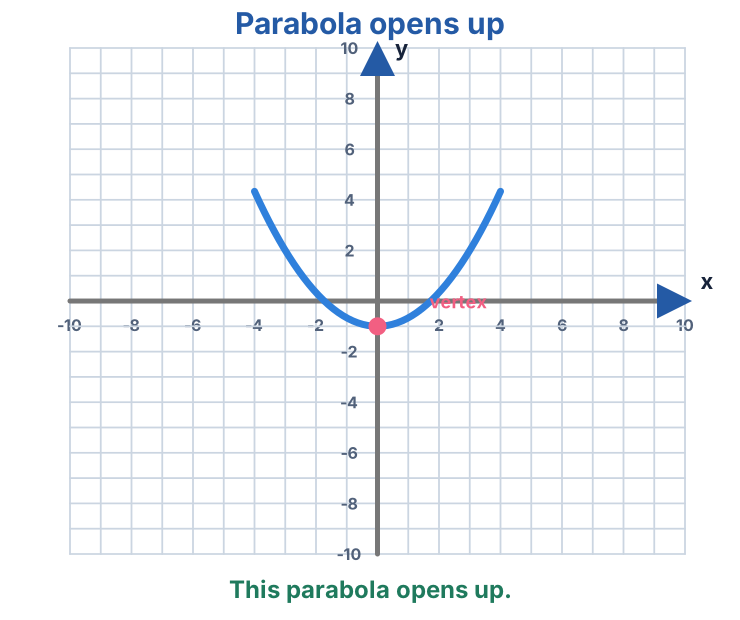
The turning point tells an important part of the story.
What you need to know for this topic
Use this as a study checklist before trying quizzes, worksheets or NAPLAN-style questions.
Quadratic structure
- squared terms
- expanding brackets
- factorising
- roots or solutions
Graphs
- parabolas
- turning points
- axis of symmetry
- intercepts
1 What this means
A quadratic rule has a squared term and often makes a curved graph. Start by learning to identify the squared term and connect its rule with the shape of the graph. A helpful visual is a value table beside a parabola. For example, this idea can be used when modelling a curved path or area relationship.
Quadratic relationships include a squared term, which creates curved patterns and often two possible solutions. In Year 9, students should first ask, 'What is the question really asking me to find?' Then they can draw a picture, make a table, use a number line, write a formula or build an equation. The final answer should match the story, the units and the size of the numbers.
- Look for the squared term and write the equation in a useful form.
- Use expansion, factorising or graph features depending on the question.
- Remember that a quadratic equation may have two solutions.
- Check solutions by substitution.
2 Important rules / ideas
A quadratic includes a term with a variable squared.
A quadratic equation can have two, one or no real roots.
Solutions should make the original equation true.
Important vocabulary
An expression or equation with a squared term.
The curved graph of a quadratic relationship.
Rewrite as multiplied factors.
The x-values where a graph crosses the x-axis.
3 Step-by-step method
- Put the equation in standard form.
- Choose a method such as factorising or formula.
- Find possible solutions.
- Check by substitution.
4 Worked examples
Expand (x + 3)(x + 2).
- Multiply each pair of terms.
- x squared + 2x + 3x + 6.
- x squared + 5x + 6.
Factorise x squared + 5x + 6.
- Find two numbers that multiply to 6 and add to 5.
- They are 2 and 3.
- Answer: (x + 2)(x + 3).
Solve x squared - 9 = 0.
- x squared = 9.
- x = 3 or x = -3.
A rectangle has sides x and x + 4. Write its area.
- Area = length x width.
- Area = x(x + 4).
- Expanded area = x squared + 4x.
5 More examples
(x + 4)(x + 1)
x squared + 5x + 4.
x squared - 16 = 0.
x = 4 or x = -4.
NAPLAN-style thinking
In NAPLAN-style questions, expand binomials and factorise quadratics may appear as a short calculation, a word problem, a diagram, a table or a multi-step reasoning question. Students should slow down and decide what the question is really asking before calculating.
Estimate first and eliminate answers that are too small, too large or use the wrong unit.
Write only the answer required, but use working on paper to avoid mental slips.
Circle the numbers, underline the action words and decide whether all numbers are needed.
Do one step at a time and label intermediate answers so the final step is clear.
6 Common mistakes
Read the final sentence before calculating.
Name the topic and method before starting.
Estimate or use inverse operations to check.
- Choosing the first operation seen in the wording.
- Forgetting units, labels or place value.
- Stopping after the first step when the question asks for a final comparison.
7 Tips to remember
The squared term is the key sign of a quadratic.
When factorising, look for numbers that multiply and add correctly.
Check each possible solution.
Parent teaching tips
- Ask your child to explain the method aloud before writing the answer.
- Use a real-life context at home, such as shopping, cooking, sport scores, maps or timetables.
- Praise clear working and checking, not only speed.
- Ask your child to write the formula or rule first, then substitute values carefully.
Remember
For expand binomials and factorise quadratics, identify the question type, choose a clear method, show working and check the answer.
8 Quick practice
- Expand (x + 3)(x + 2).
- Factorise x squared + 5x + 6.
- Solve x squared - 9 = 0.
- A rectangle has sides x and x + 4. Write its area.
9 Answers / explanation
Question 1
Answer: x squared + 5x + 6.
Multiply each pair of terms. x squared + 2x + 3x + 6. x squared + 5x + 6.
Question 2
Answer: (x + 2)(x + 3).
Find two numbers that multiply to 6 and add to 5. They are 2 and 3. Answer: (x + 2)(x + 3).
Question 3
Answer: x = 3 or x = -3.
x squared = 9. x = 3 or x = -3.
Question 4
Answer: Expanded area = x squared + 4x.
Area = length x width. Area = x(x + 4). Expanded area = x squared + 4x.
Extension challenge
Write an equation or rule for a real-life situation, solve it, then check by substitution.
Hint: Use tickets, taxi fares, savings, distances or growing patterns.
Answer guide
Answers will vary. A strong answer includes clear working, correct units and a final sentence.
Quick revision
- Know what expand binomials and factorise quadratics is asking you to find.
- Choose a diagram, table, formula, number line or equation before calculating.
- Show enough working that you can find and fix mistakes.
- Check the final answer, units and reasonableness.