
Mathematics classroom notes
Year 9 - Simple interest and financial maths
Strand / topic: Number and Algebra / Simple interest and financial maths
Based on Pi Leo Academy's Victorian Curriculum F-10 Mathematics year-level guide and aligned to NAPLAN-style mathematical reasoning. Official curriculum code: Not stated in the provided curriculum source.
By the end of this note, students should be able to explain simple interest and financial maths, use a clear method, solve simple and test-style questions, and check their answers for Year 9 Number and Algebra work.
It builds number sense, reasoning and confidence for classwork, quizzes and problem solving. This is a NAPLAN year, so students should practise reading the question carefully, choosing the correct operation or formula, showing working and checking whether the answer is reasonable.
What does percent mean?
Percent means out of 100 equal parts.
If 25 out of 100 squares are shaded, that is 25%.
For Year 9, focus on understanding the idea before rushing to the final answer.
Think about it: discounts, test scores and battery charge all use percentages.
Use this visual to organise simple interest and financial maths before calculating.
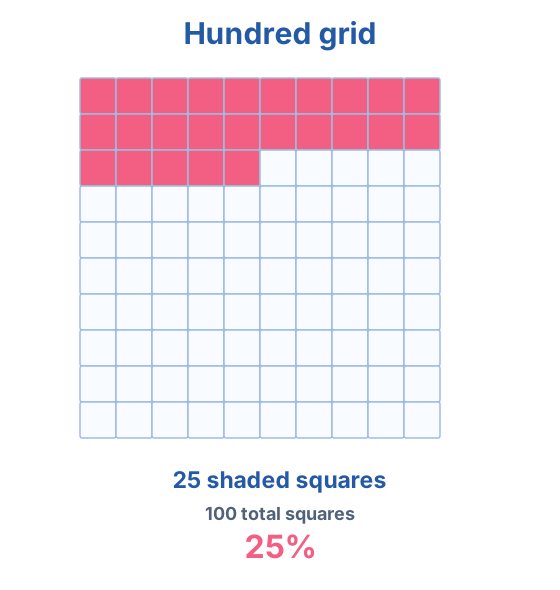
Think of the whole as 100 equal squares.
What you need to know for this topic
Use this as a study checklist before trying quizzes, worksheets or NAPLAN-style questions.
Percent meaning
- understand percent as out of 100
- connect percentages to fractions and decimals
- use benchmark percentages such as 10%, 25%, 50% and 75%
Real-life uses
- discounts
- increases and decreases
- simple interest contexts
- test scores and battery-style displays
1 What this means
A percentage shows how many parts out of 100. Start by learning to connect the amount to 100, using an equivalent fraction or decimal when helpful. A helpful visual is a hundred grid or double number line. For example, this idea can be used when interpreting a discount, score or change in value.
Percentages compare amounts using 100 equal parts, which makes different quantities easier to compare. In Year 9, students should first ask, 'What is the question really asking me to find?' Then they can draw a picture, make a table, use a number line, write a formula or build an equation. The final answer should match the story, the units and the size of the numbers.
- Start by identifying the mathematical structure, then choose the most efficient representation.
- Underline the key information and decide what is being asked.
- Choose a diagram, table, equation or number sentence.
- Check the answer against the original question.
2 Important rules / ideas
Decide whether the problem combines, compares, repeats, shares or groups before calculating.
In written addition and subtraction, ones stay with ones, tens stay with tens and so on.
Use subtraction to check addition, addition to check subtraction, division to check multiplication and multiplication to check division.
Important vocabulary
A number out of 100.
A reduction in price.
Money added to savings or debt.
An amount getting larger.
3 Step-by-step method
- Identify the whole amount.
- Convert the percentage to a fraction or decimal.
- Find the required part, increase or decrease.
- Check that the answer is sensible.
4 Worked examples
Find 10% of $80.
- 10% means one tenth.
- $80 / 10 = $8.
- 10% of $80 is $8.
Find 25% of 120.
- 25% is one quarter.
- 120 / 4 = 30.
- 25% of 120 is 30.
A $60 jacket is discounted by 15%. Find the discount.
- 10% of $60 is $6.
- 5% is half of 10%, so $3.
- 15% is $6 + $3 = $9.
A score increases from 40 to 50. What is the increase?
- Increase = 50 - 40 = 10.
- 10 is one quarter of 40.
- The increase is 25%.
5 More examples
Find 50% of 86.
50% is half, so half of 86 is 43.
A $40 game is 10% off.
10% of $40 is $4, so the sale price is $36.
NAPLAN-style thinking
In NAPLAN-style questions, simple interest and financial maths may appear as a short calculation, a word problem, a diagram, a table or a multi-step reasoning question. Students should slow down and decide what the question is really asking before calculating.
Estimate first and eliminate answers that are too small, too large or use the wrong unit.
Write only the answer required, but use working on paper to avoid mental slips.
Circle the numbers, underline the action words and decide whether all numbers are needed.
Do one step at a time and label intermediate answers so the final step is clear.
6 Common mistakes
Read the final sentence before calculating.
Name the topic and method before starting.
Estimate or use inverse operations to check.
- Choosing the first operation seen in the wording.
- Forgetting units, labels or place value.
- Stopping after the first step when the question asks for a final comparison.
7 Tips to remember
A quick diagram helps you decide what to do.
Finish one calculation before starting the next.
Return to the final sentence and check your units.
Parent teaching tips
- Ask your child to explain the method aloud before writing the answer.
- Use a real-life context at home, such as shopping, cooking, sport scores, maps or timetables.
- Praise clear working and checking, not only speed.
- Ask your child to write the formula or rule first, then substitute values carefully.
Remember
Percent means out of 100.
8 Quick practice
- Find 10% of $80.
- Find 25% of 120.
- A $60 jacket is discounted by 15%. Find the discount.
- A score increases from 40 to 50. What is the increase?
9 Answers / explanation
Question 1
Answer: 10% of $80 is $8.
10% means one tenth. $80 / 10 = $8. 10% of $80 is $8.
Question 2
Answer: 25% of 120 is 30.
25% is one quarter. 120 / 4 = 30. 25% of 120 is 30.
Question 3
Answer: 15% is $6 + $3 = $9.
10% of $60 is $6. 5% is half of 10%, so $3. 15% is $6 + $3 = $9.
Question 4
Answer: The increase is 25%.
Increase = 50 - 40 = 10. 10 is one quarter of 40. The increase is 25%.
Extension challenge
Create your own multi-step question for this topic using an Australian context, then solve it and explain each step.
Hint: Use shopping, sport, maps, timetables, weather, school events or measurement at home.
Answer guide
Answers will vary. A strong answer includes clear working, correct units and a final sentence.
Quick revision
- Know what simple interest and financial maths is asking you to find.
- Choose a diagram, table, formula, number line or equation before calculating.
- Show enough working that you can find and fix mistakes.
- Check the final answer, units and reasonableness.