
Place value to 10 000
A clear starting point, worked steps and space to practise.
Start here
Thousands, hundreds, tens and ones help us read and compare numbers up to ten thousand.
Compare from the left, not the last digit. A larger ones digit cannot outweigh a larger tens digit.
1 Work through these steps
- Name each place from the left.
- Write each non-zero digit’s value.
- For a comparison, find the first place where the numbers differ.
- Check by reading both numbers aloud.
2 Follow a worked example
Which is greater: 4,508 or 4,580?
- Both have 4 thousands and 5 hundreds.
- Compare tens: 0 tens and 8 tens.
- 4,580 is greater.
3 Try it yourself
Show each step on paper or open Working out. Then check the answer.
-
Write 6,203 in expanded form.
Check answer 1
Answer: 6,000 + 200 + 3
The zero holds the tens place.
Scratchpad · Not saved
Working out
Draw with a finger, pen or mouse, or type your working below.
Your working stays on this page. It is not submitted or saved, and clears when you leave or reload.
Check your understanding
Explain the worked example in your own words. Say why the method works, not just what the answer is.
Skills and explanation links
Key ideas taught here
- Thousands, hundreds, tens and ones help us read and compare numbers up to ten thousand.
- Compare from the left, not the last digit. A larger ones digit cannot outweigh a larger tens digit.
Method and checking
Optional recap: related Maths skills
These earlier examples revisit background skills. Start with the topic example and practice above.
Useful vocabulary
- digit
- A symbol from 0 to 9 used to write numbers.
- place value
- The value of a digit because of its position in a number.
- round
- Change a number to a nearby easier number.
- estimate
- A sensible approximate answer used to check reasonableness.
Rules for these related skills
Compare numbers from the largest place value, then move right only if the digits are the same.
For a positive whole number using the school halfway-up rule, check the next digit: 5–9 rounds the chosen place up; 0–4 keeps it unchanged.
Expanded form shows the value of every digit, such as 4 582 = 4 000 + 500 + 80 + 2.
Write 4 582 in expanded form.
- 4 thousands + 5 hundreds + 8 tens + 2 ones.
- 4 582 = 4 000 + 500 + 80 + 2.
Round 36 748 to the nearest thousand.
- Look at the thousands digit: 6.
- Check the hundreds digit: 7.
- Because 7 is 5 or more, round up to 37 000.
Order 8 905, 8 590 and 9 058 from smallest to largest.
- Compare thousands first.
- 8 590 and 8 905 both have 8 thousands, so compare hundreds.
- Smallest to largest: 8 590, 8 905, 9 058.
A school raised 12 486 points. About how many points is this to the nearest thousand?
- The hundreds digit is 4.
- Round down to 12 000.
- About 12 000 points were raised.
More visual models and everyday examples
Each everyday example has its own information and model. Use its stated values rather than copying values from another question.
Concept example. The story examples below have their own diagrams.
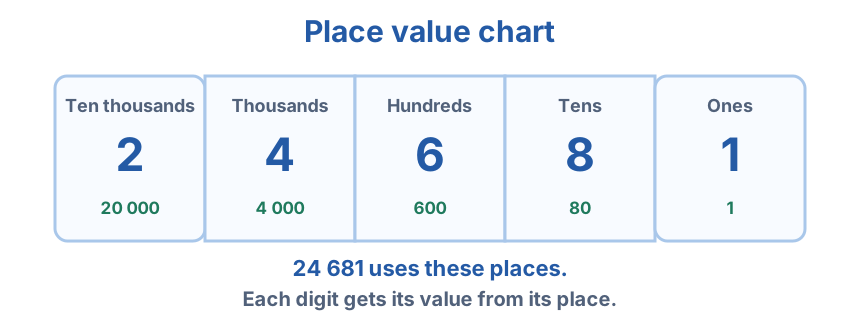
Say the value of each digit aloud before comparing or rounding.
For parents and teachers
- Ask your child to explain the method aloud before writing the answer.
- Use a real-life context at home, such as shopping, cooking, sport scores, maps or timetables.
- Praise clear working and checking, not only speed.
- Encourage a quick diagram or table for word problems before calculating.
Practise choosing a method from the information in the question. The examples here are Pi Leo Academy learning activities. Official NAPLAN testing takes place in Years 3, 5, 7 and 9; a topic appearing in these notes does not mean it is tested in NAPLAN.
These notes provide guided examples and practice; they do not certify completion of every curriculum requirement.