
0120 questions
Start with one qubit
Qubits, superposition and measurement
Learn what a qubit describes, what a measurement reveals, and why quantum information needs more than a list of probabilities.
~35 min learningOpen section →
FOUNDATIONS · CERTIFICATE COURSE
How can small quantum computers work together? Build your understanding one idea at a time — from a single qubit to a network of processors.
No quantum background, coding or advanced maths required.
YOUR LEARNING PATH
You’ll learn what a qubit can tell us, how entanglement becomes a resource, and why quantum computers still need classical messages. Then follow a state through teleportation and explore the costs of working across modules.
Lessons are open to read. Sign in to submit quizzes and save progress. Each section has one 20-question quiz, with unlimited retakes and explanations after submission.
YOUR CERTIFICATE
Score at least 16 out of 20 in every section. Your best score counts.
Sign in to save progress →Issued to the signed-in account holder by Pi Leo Academy. A certificate of completion, not an accredited qualification or professional licence.
THE CURRICULUM
Start with one qubit
Learn what a qubit describes, what a measurement reveals, and why quantum information needs more than a list of probabilities.
Build a shared quantum resource
Follow a simple circuit, create a Bell pair, and understand the limits that make quantum networking different from copying classical data.
Connect modules
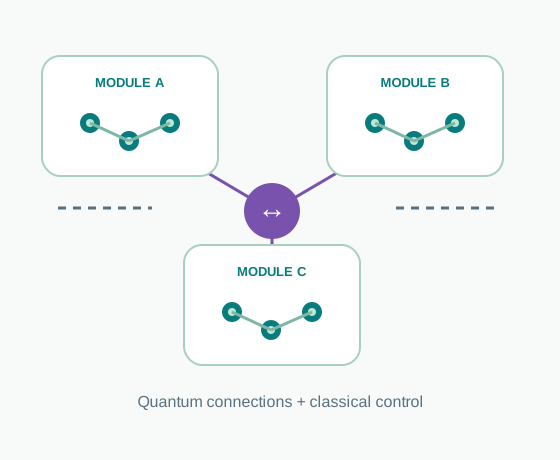
Meet the processors, quantum links, classical messages and memories needed when a computation spans more than one quantum module.
Follow the information
Trace a three-qubit protocol, read its correction table, and see why teleportation creates neither a copy nor an instant message.
Make the modules cooperate
Turn a small circuit into a plan for two modules, account for communication, and understand why good placement matters.
Read the claims carefully
Separate successful link attempts from high-quality results, understand error correction, and assess a real experiment without overclaiming.
Lessons, examples, questions and diagrams were written for this course. Each section links to the technical sources used to check its ideas. Diagrams are original teaching schematics; they are not photographs of real hardware.
We separate ideal protocols, illustrative calculations and dated research results. The course makes no promise of faster-than-light messaging or automatic computational speed-up.