
Choosing appropriate units of measurement
A clear starting point, worked steps and space to practise.
Start here
Choose a unit that matches both the kind of measurement and its size.
The quantity matters before the size: kilograms cannot measure length, even for a large object.
1 Work through these steps
- Decide whether you are measuring length, mass, capacity, time or temperature.
- Choose a matching unit.
- Pick a scale that avoids an unnecessarily huge or tiny number.
- Check the measuring tool and label the answer.
2 Follow a worked example
Choose a sensible unit for the length of a pencil: centimetres or kilometres.
- A pencil is a small length.
- Centimetres suit small everyday lengths.
- Use centimetres.
3 Try it yourself
Show each step on paper or open Working out. Then check the answer.
-
Choose a sensible unit for the capacity of a drinking cup: millilitres or kilometres.
Check answer 1
Answer: Millilitres (mL)
Capacity measures how much liquid fits, so use a capacity unit.
Scratchpad · Not saved
Working out
Draw with a finger, pen or mouse, or type your working below.
Your working stays on this page. It is not submitted or saved, and clears when you leave or reload.
Check your understanding
Explain the worked example in your own words. Say why the method works, not just what the answer is.
Skills and explanation links
Key ideas taught here
- Choose a unit that matches both the kind of measurement and its size.
- The quantity matters before the size: kilograms cannot measure length, even for a large object.
Method and checking
Optional recap: related Maths skills
These earlier examples revisit background skills. Start with the topic example and practice above.
Useful vocabulary
- length
- How long, wide or tall something is.
- mass
- How heavy something is.
- capacity
- How much a container can hold.
- scale
- A set of marks that shows measured values, such as on a ruler, thermometer or map.
Rules for these related skills
Length, mass, capacity, temperature and distance use different tools and units.
Use mm, cm, m and km for length; g and kg for mass; mL and L for capacity; °C for temperature.
Check what each tick mark represents before reading a ruler, thermometer, jug, scale or map.
Which unit is best for the length of a pencil: cm or km?
- A pencil is a small length.
- Centimetres measure small lengths.
- Use cm.
Which unit is best for water in a cup: mL or kg?
- Water in a cup is a capacity amount.
- Small capacity amounts use millilitres.
- Use mL.
Which unit is best for the mass of a school bag: g or kg?
- A school bag is heavier than a small object.
- Kilograms are sensible for heavier everyday objects.
- Use kg.
A weather report says the day will be 28. Which unit should be written after 28?
- Weather reports measure temperature.
- Temperature uses degrees Celsius.
- Write 28°C.
More visual models and everyday examples
Each everyday example has its own information and model. Use its stated values rather than copying values from another question.
Concept example. The story examples below have their own diagrams.
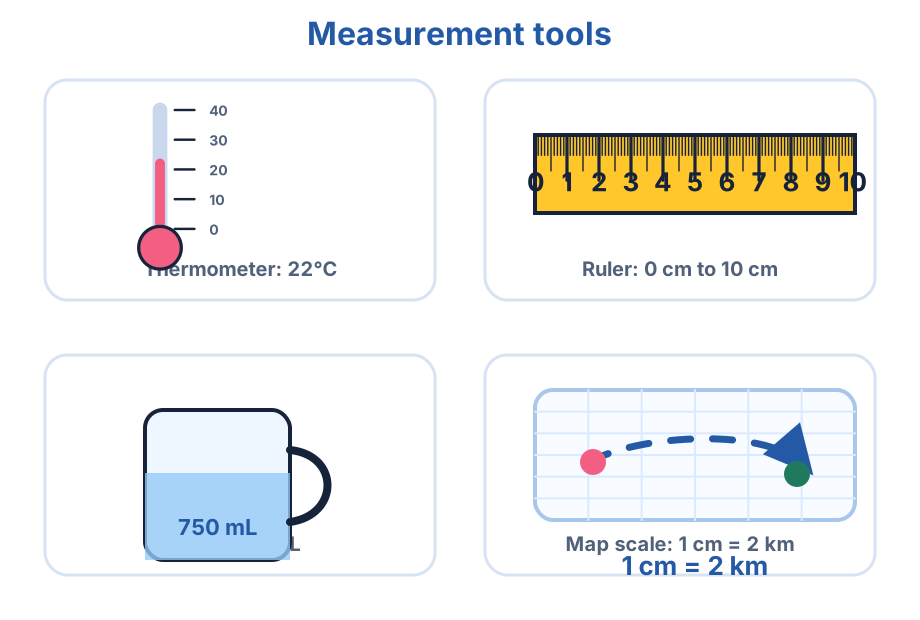
Choose the attribute first: length, mass, capacity, temperature or distance.
For parents and teachers
- Ask your child to explain the method aloud before writing the answer.
- Use a real-life context at home, such as shopping, cooking, sport scores, maps or timetables.
- Praise clear working and checking, not only speed.
- Encourage a quick diagram or table for word problems before calculating.
Practise choosing a method from the information in the question. The examples here are Pi Leo Academy learning activities. Official NAPLAN testing takes place in Years 3, 5, 7 and 9; a topic appearing in these notes does not mean it is tested in NAPLAN.
These notes provide guided examples and practice; they do not certify completion of every curriculum requirement.