
Operations with positive and negative integers
A clear starting point, worked steps and space to practise.
Start here
For signed numbers, keep the operation separate from each number’s sign.
The sign rule for multiplication is not a rule for addition. For example, −4 + 7 is not negative just because the signs differ.
1 Work through these steps
- For addition, think of movement on a number line.
- Rewrite subtraction as adding the opposite.
- For multiplication or division, use same signs positive and different signs negative.
- Check the result with a small model or inverse operation.
2 Follow a worked example
Calculate −4 − (−7).
- Subtracting −7 means adding its opposite, +7.
- −4 + 7 = 3.
- The answer is 3.
3 Try it yourself
Show each step on paper or open Working out. Then check the answer.
-
Calculate (−6) × (−3).
Check answer 1
Answer: 18
Two negative factors give a positive product; 6 × 3 = 18.
Scratchpad · Not saved
Working out
Draw with a finger, pen or mouse, or type your working below.
Your working stays on this page. It is not submitted or saved, and clears when you leave or reload.
Check your understanding
Explain the worked example in your own words. Say why the method works, not just what the answer is.
Skills and explanation links
Key ideas taught here
- For signed numbers, keep the operation separate from each number’s sign.
- The sign rule for multiplication is not a rule for addition. For example, −4 + 7 is not negative just because the signs differ.
Method and checking
Optional recap: related Maths skills
These earlier examples revisit background skills. Start with the topic example and practice above.
Useful vocabulary
- sum
- The answer to an addition problem.
- difference
- The answer to a subtraction problem.
- product
- The answer to a multiplication problem.
- quotient
- The answer to a division problem.
Rules for these related skills
Decide whether the problem combines, compares, repeats, shares or groups before calculating.
In written addition and subtraction, ones stay with ones, tens stay with tens and so on.
Use subtraction to check addition, addition to check subtraction, division to check multiplication and multiplication to check division.
Work out 48 + 35.
- Add ones: 8 + 5 = 13.
- Write 3 ones and trade 1 ten.
- Add tens: 4 + 3 + 1 = 8.
- Answer: 83.
Work out 306 - 178.
- Trade 1 hundred so 0 tens becomes 10 tens.
- Trade 1 ten so 6 ones becomes 16 ones.
- 16 - 8 = 8, 9 - 7 = 2, 2 - 1 = 1.
- Answer: 128.
Calculate 24 x 6.
- Break 24 into 20 and 4.
- 20 x 6 = 120.
- 4 x 6 = 24.
- 120 + 24 = 144.
Four students share 96 stickers equally. How many does each get?
- Sharing equally means division.
- 96 / 4 = 24.
- Each student gets 24 stickers.
More visual models and everyday examples
Each everyday example has its own information and model. Use its stated values rather than copying values from another question.
Concept example. The story examples below have their own diagrams.
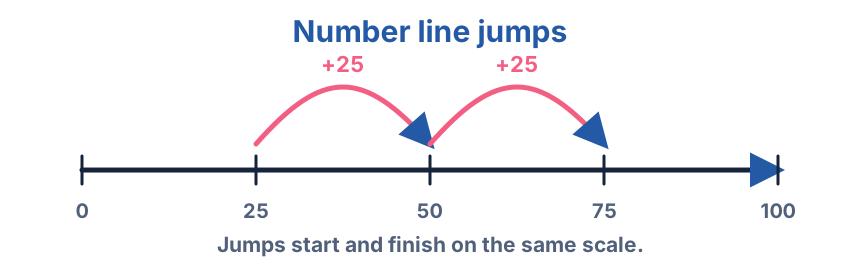
Draw the jumps first, then write the number sentence.
For parents and teachers
- Ask your child to explain the method aloud before writing the answer.
- Use a real-life context at home, such as shopping, cooking, sport scores, maps or timetables.
- Praise clear working and checking, not only speed.
- Ask your child to write the formula or rule first, then substitute values carefully.
Practise choosing a method from the information in the question. The examples here are Pi Leo Academy learning activities. Official NAPLAN testing takes place in Years 3, 5, 7 and 9; a topic appearing in these notes does not mean it is tested in NAPLAN.
These notes provide guided examples and practice; they do not certify completion of every curriculum requirement.