
Measurement — reading a thermometer
A clear starting point, worked steps and space to practise.
Start here
A thermometer uses a scale to show temperature. Read the value of each gap before reading the liquid level.
Count gaps, not tick marks. Six boundary marks make five gaps.
1 Work through these steps
- Read the unit and two labelled marks.
- Subtract the lower label from the upper label.
- Divide by the number of equal gaps between them.
- Count gaps up to the reading.
2 Follow a worked example
A thermometer has five equal gaps between 20°C and 30°C. The level is three gaps above 20°C. What is the temperature?
- The labels differ by 10 degrees.
- 10 ÷ 5 = 2 degrees per gap.
- Three gaps mean 6 degrees above 20°C.
- The reading is 26°C.
3 Try it yourself
Show each step on paper or open Working out. Then check the answer.
-
There are five equal gaps between 10°C and 20°C. What is two gaps above 10°C?
Check answer 1
Answer: 14°C
Each gap is 2 degrees; 10 + 2 × 2 = 14°C.
Scratchpad · Not saved
Working out
Draw with a finger, pen or mouse, or type your working below.
Your working stays on this page. It is not submitted or saved, and clears when you leave or reload.
Check your understanding
Explain the worked example in your own words. Say why the method works, not just what the answer is.
Skills and explanation links
Key ideas taught here
- A thermometer uses a scale to show temperature. Read the value of each gap before reading the liquid level.
- Count gaps, not tick marks. Six boundary marks make five gaps.
Method and checking
Optional recap: related Maths skills
These earlier examples revisit background skills. Start with the topic example and practice above.
Useful vocabulary
- length
- How long, wide or tall something is.
- mass
- How heavy something is.
- capacity
- How much a container can hold.
- scale
- A set of marks that shows measured values, such as on a ruler, thermometer or map.
Rules for these related skills
Length, mass, capacity, temperature and distance use different tools and units.
Use mm, cm, m and km for length; g and kg for mass; mL and L for capacity; °C for temperature.
Check what each tick mark represents before reading a ruler, thermometer, jug, scale or map.
A thermometer shows 24°C. Is this closer to freezing water or a warm day?
- Freezing water is 0°C.
- 24°C is much warmer than 0°C.
- It is closer to a warm day.
The red line is halfway between 20°C and 30°C. What is the temperature?
- Halfway means the middle value.
- The middle of 20 and 30 is 25.
- The temperature is 25°C.
A morning temperature is 9°C and the afternoon temperature is 23°C. How much warmer is the afternoon?
- Compare by subtracting.
- 23 - 9 = 14.
- The afternoon is 14°C warmer.
The fridge is 4°C and the classroom is 22°C. Which is warmer, and by how much?
- 22°C is greater than 4°C.
- 22 - 4 = 18.
- The classroom is warmer by 18°C.
More visual models and everyday examples
Each everyday example has its own information and model. Use its stated values rather than copying values from another question.
Concept example. The story examples below have their own diagrams.
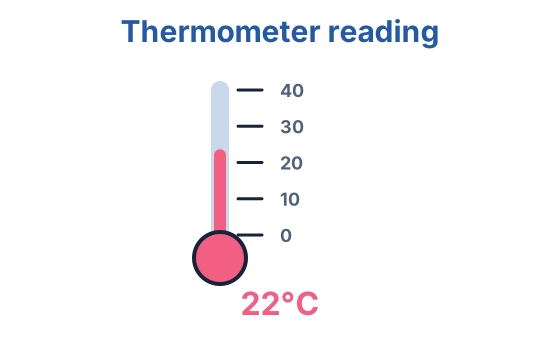
Choose the attribute first: length, mass, capacity, temperature or distance.
For parents and teachers
- Ask your child to explain the method aloud before writing the answer.
- Use a real-life context at home, such as shopping, cooking, sport scores, maps or timetables.
- Praise clear working and checking, not only speed.
- Encourage a quick diagram or table for word problems before calculating.
Practise choosing a method from the information in the question. The examples here are Pi Leo Academy learning activities. Official NAPLAN testing takes place in Years 3, 5, 7 and 9; a topic appearing in these notes does not mean it is tested in NAPLAN.
These notes provide guided examples and practice; they do not certify completion of every curriculum requirement.