
By the end, you can…
- Distinguish loss, decoherence, gate errors and measurement errors.
- Explain why heralding, fidelity and generation rate measure different things.
- Distinguish physical qubits from encoded logical qubits without invoking cloning.
- Evaluate experimental and vendor claims using stated metrics, conditions and dates.
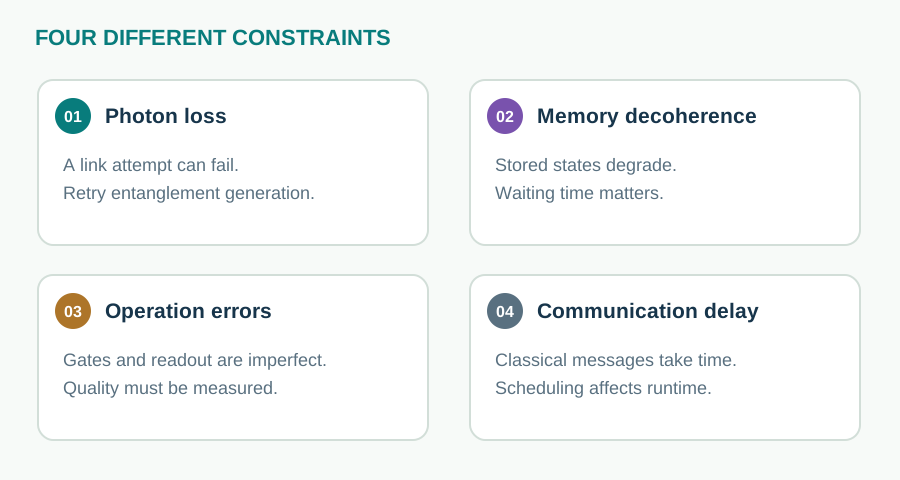
A working protocol still needs reliable hardware
Our earlier circuits described ideal operations. A real device can depart from that model during preparation, storage, gates, communication and measurement. A gate may rotate a state by the wrong amount. A measurement can report the wrong outcome. A photon carrying quantum information may be lost before it reaches a detector. These are different problems, and a single number called 'accuracy' may hide which one was measured.
Decoherence describes degradation of quantum coherence through interaction with the surroundings. For example, uncontrolled phase changes can spoil interference even when a later 0/1 measurement still looks balanced. Waiting is therefore not necessarily harmless: a data qubit can accumulate errors while a link tries to prepare entanglement. Loss means a carrier or expected detection is missing; it is not simply another name for every type of phase error.
Three questions for every entanglement link
First ask whether a suitable event was signalled. A herald is a classical indication that an entanglement-generation attempt met the protocol's success condition, often based on detector events. It lets a controller decide when to proceed. Real heralding systems can have imperfections, so a success flag is not proof that the resulting state is a perfect Bell state.
Next ask about quality. State fidelity describes closeness to a chosen target state, under a stated mathematical convention; ideal agreement has fidelity 1. Gate fidelity instead characterizes an operation relative to a target operation. Neither should be silently replaced by an algorithm's probability of returning a correct answer. Finally ask about rate: how many usable pairs are generated per second under the stated conditions? High fidelity and high rate are separate goals, and waiting time matters to the larger computation.
- Heralding: which signal told the controller that an attempt succeeded?
- Fidelity: which target state or operation was compared, and how was it estimated?
- Rate and latency: how often are resources available, and how long must data wait?
Protect information by encoding it
A physical qubit is a hardware carrier of quantum information. In a quantum error-correcting code, logical quantum information is encoded across physical degrees of freedom. Extra qubits, gates and measurements support checks for error patterns. A logical qubit is therefore not a claim that one particular hardware qubit has become perfect, and a physical-qubit count cannot be read directly as the number of protected logical qubits.
Error checks produce a syndrome: classical information used to infer a suitable response to errors. Properly designed checks reveal error information without reading out the encoded unknown state itself. The encoding is not a collection of independent copies, so it does not bypass the no-cloning theorem. Correction also has limits. The code, error pattern, quality of its operations and decoding method determine whether the logical information is successfully protected.
Fault-tolerant operation includes protecting information while computing, so that faults do not spread into unmanageable logical errors. More hardware alone does not guarantee this. Error mitigation is another term you may encounter: it uses methods to reduce the effect of noise on estimated results, but should not automatically be described as a fully error-corrected computation. Check exactly what a demonstration performed.
A dated example of experimental evidence
Main and colleagues reported a distributed-computing experiment in Nature on 5 February 2025. They connected two trapped-ion modules separated by about two metres using an optical link. After heralded remote entanglement, they implemented a remote controlled-Z gate and reported about 86% average gate fidelity. A distributed Grover-search demonstration achieved a 71% success rate. These are distinct reported metrics for that experiment. They show an experimental implementation; they do not establish that every distributed computation outperforms a classical computer or that all scaling problems are solved.
A practical checklist for reading the next announcement
Start with the task and the evidence: was this hardware, a simulation, a proposal or a future target? Record the date, the number of connected modules, the distance, and which operations actually crossed the connection. Check whether a headline counts physical qubits, encoded logical qubits or merely access to separate machines. Ask whether reported performance includes failed attempts, communication delays and memory errors.
Then inspect the comparison. Were the same problem, success criterion and total resources used? Were some runs discarded after the fact, and if so how many? Are uncertainty estimates and methods available? A laboratory milestone can be valuable without proving a commercial advantage. The broader quantum-internet vision develops through different capabilities; a successful small network does not by itself demonstrate a worldwide, fault-tolerant computing service.
WORKED EXAMPLE
Compute a rate without confusing it with quality
This is a hypothetical calculation, not a hardware benchmark. A link makes 100 independent attempts per second. Each attempt has a fixed 10% chance of a valid herald. Ignore reset, storage and scheduling overhead. The expected rate is 100 × 0.10 = 10 heralded pairs per second. The expected number of attempts until one success is 1/0.10 = 10; any individual wait can be shorter or longer.
Now suppose a separate characterization estimates the heralded states' fidelity to the target Bell state as 0.95. The number 0.95 does not mean that 95% of all attempts generate a pair, nor that every algorithm using a pair succeeds 95% of the time. A buyer would still need operation quality, storage behaviour and the complete application's measured results. The calculation separates availability from quality instead of combining unlike metrics.
Common misconceptions
Misconception: Heralded means perfect.
What to remember: A herald reports a success condition. State quality still needs characterization, and real heralds can be imperfect.
Misconception: Error correction makes independent backups of an unknown state.
What to remember: Quantum information is encoded in a joint state, and error checks extract syndromes rather than copies of the data.
Misconception: A reported gate fidelity is the success rate of every algorithm.
What to remember: State fidelity, gate fidelity and application success are different measures with different definitions and conditions.
A small glossary
- Decoherence
- Loss or degradation of quantum coherence through interactions with an environment.
- Herald
- A classical signal that a specified event or protocol success condition occurred.
- Fidelity
- A measure of agreement with a specified target state or operation; its definition and estimation method must be stated.
- Logical qubit
- A unit of quantum information represented within an encoding, rather than identified with one bare physical carrier.
- Syndrome
- Results of error checks used to infer errors and select a response without directly reading the encoded unknown state.
- Fault tolerance
- Designing encoded computation so that sufficiently limited faults can be controlled rather than becoming uncorrectable logical errors.
Take these ideas with you
- Successful resource generation, resource quality and generation speed are different measures.
- Quantum error correction uses encoding and error checks, not independent copies of unknown states.
- Read dated experimental results with their actual task, methods and limits; do not infer universal speedup from a milestone.
Sources & further reading
Use these to explore the science behind this section. The explanations and teaching figures here are original.
- IBM Quantum Learning — Noise and errors ↗
Background on physical noise, dephasing and the distinction between noise mechanisms and their error models.
- IBM Quantum Learning — Correcting quantum errors ↗
Foundational context for encoding and the need to protect fragile quantum information.
- IBM Quantum Learning — Fault-tolerant quantum computing ↗
Protecting logical information during operations, with imperfect physical components and finite code capability.
- IBM Quantum Learning — Stabilizer codes ↗
Details of encoding, error syndromes and recovery. Included for further reading; the mathematics is beyond this introductory course.
- IBM Quantum Learning — Error mitigation ↗
Distinguishes reducing noise effects in estimated results from protecting encoded quantum states during execution.
- Main et al. (2025) — Distributed quantum computing across an optical network link ↗
Primary experimental paper, published 5 February 2025. Approximately 2 m separation, about 86% remote-CZ average gate fidelity, and 71% Grover-search success are different reported results.
- Wehner, Elkouss and Hanson (2018) — Quantum internet: A vision for the road ahead ↗
Research perspective on staged quantum-network capabilities and the development needed for a broader quantum internet.
Ready to check your understanding?
20 questions. Aim for 16 correct. You can revisit the lesson and retake the quiz.
Take the section quiz →