
By the end, you can…
- Identify the quantum and classical resources used in ideal qubit teleportation.
- Use two measurement bits to choose Bob's correction.
- Explain why the protocol respects no-cloning and the speed limit on communication.
- Distinguish a transferred quantum state from transported matter.
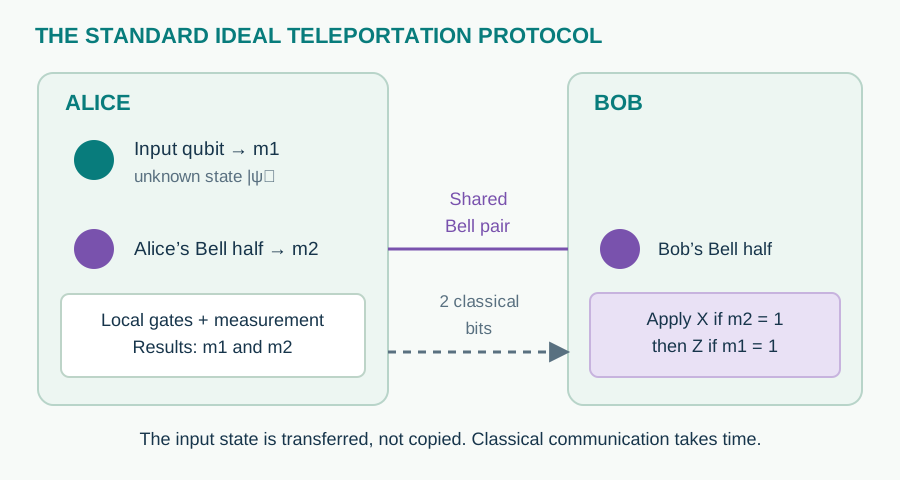
A transfer, with three clearly labelled qubits
Alice has an input qubit Q whose state must become available at Bob's module. Call its state |ψ⟩, pronounced 'psi'. Alice does not need to know a recipe for preparing it. Bob already holds a different physical qubit B. The task is to make B carry the input state, while preserving its quantum information. Neither a person nor a material object disappears and reappears.
For this lesson we assume ideal gates, measurements and storage. Alice and Bob first share the Bell pair (|00⟩ + |11⟩)/√2. Alice holds its qubit A; Bob holds its qubit B. Including the separate input Q, there are three qubits: Q and A at Alice, B at Bob. The Bell pair must have been established through a physical quantum process. An ordinary message alone cannot create it between the modules.
The operations, one step at a time
Alice applies a controlled-NOT gate with Q as the control and A as the target. On basis states, this flips A exactly when Q is 1. She next applies a Hadamard gate H to Q. These operations prepare her two qubits for the measurements required by the protocol. Measuring the untouched input directly and emailing the result would be a different procedure, and would lose information about an arbitrary input state.
Alice measures both of her qubits in the computational basis. We call the outcome from Q m1, and the outcome from A m2. She sends these two ordinary bits to Bob. The bit labels matter: swapping them would swap the correction rules. In the ideal protocol the four messages 00, 01, 10 and 11 are equally likely, regardless of the input state. These bits specify a correction; they are not a small classical description of |ψ⟩.
- Prepare the shared Bell pair; keep Q separate until the protocol begins.
- Apply CNOT from Q to A, then H to Q.
- Measure Q to obtain m1 and A to obtain m2; send both bits to Bob.
- Bob applies X if m2 = 1, then Z if m1 = 1.
Read the correction table
X exchanges |0⟩ and |1⟩. Z leaves |0⟩ unchanged and reverses the sign of the |1⟩ part; this changes a relative phase. Bob uses the message to undo the corresponding change to his state. Written compactly, the instruction is 'apply X^m2, then Z^m1'. An exponent 0 means skip that gate; an exponent 1 means apply it. In matrix notation the combined operation is Z^m1 X^m2 because the rightmost operation acts first.
Always read our messages in the order m1m2. For 00, Bob does nothing. For 01, he applies X. For 10, he applies Z. For 11, he applies X followed by Z. Each branch produces the same desired output state in the ideal model. The randomness selects the repair instruction; it does not select a different final answer after the repair.
What the protocol spends and what it preserves
One completed transfer consumes one shared Bell pair and communicates two classical bits in this standard protocol. Alice's original unknown state is no longer available on her measured qubit. The pair cannot simply be used again as the same entanglement resource. Another transfer requires another suitable resource, plus the necessary operations and communication.
Bob cannot use entanglement to read Alice's unknown state or a chosen message before her classical information arrives. Without that information his local measurement statistics reveal no usable signal from Alice. Thus teleportation does not communicate faster than light. The protocol can also transfer a qubit that is entangled with other qubits: ideal teleportation preserves those correlations, now involving Bob's output. That feature will let us move part of a computation in the next section.
WORKED EXAMPLE
Follow one branch with a known test input
For a classroom check, prepare Q in |0⟩ and suppose Alice obtains m1m2 = 01. This branch occurs with probability 1/4 in the ideal protocol. Before correction, Bob's qubit is |1⟩. The table tells him to apply X, which changes |1⟩ into |0⟩. He has recovered the test input on a different physical qubit.
Do not conclude that teleportation is merely sending the digit 0. The same circuit must work for superpositions and entangled inputs. Testing only |0⟩ checks one case. For example, measuring |+⟩ = (|0⟩ + |1⟩)/√2 only in the computational basis cannot distinguish it from a 50:50 classical mixture; phase-sensitive checks are also needed to verify a quantum transfer.
TRY THE CLASSICAL CONTROL STEP
Which correction does Bob need?
In the convention above, m1 is Alice’s input-qubit result; m2 is her Bell-pair-qubit result. Select the two bits to explore the rule.
An ideal protocol explainer, not a hardware simulation. Alice cannot choose her measurement results. The classical message must arrive before Bob can complete the correction.
Common misconceptions
Misconception: Alice keeps a spare copy after teleportation.
What to remember: Her measurements remove the original unknown state from her input qubit. The protocol transfers quantum information without producing a second copy.
Misconception: The two classical bits contain the complete state.
What to remember: They identify one of four corrections. The shared entanglement and local quantum operations are also essential.
Misconception: An entangled connection delivers an instant usable message.
What to remember: Bob needs Alice's classical message; entanglement alone does not let her signal to him.
A small glossary
- Quantum teleportation
- A protocol transferring quantum information using shared entanglement, local operations and classical communication.
- Feed-forward
- Using an earlier measurement result to choose a later operation.
- Pauli X
- The single-qubit gate exchanging the computational basis states |0⟩ and |1⟩.
- Pauli Z
- The single-qubit gate changing the sign of the |1⟩ amplitude relative to |0⟩.
- Computational basis
- The standard single-qubit measurement basis with possible outcomes labelled 0 and 1.
Take these ideas with you
- The standard ideal protocol uses three qubits, one shared Bell pair and two classical message bits.
- With m1 from the input and m2 from Alice's Bell qubit, apply X for m2 and then Z for m1.
- The state moves; it is not copied, and no faster-than-light message becomes available.
Sources & further reading
Use these to explore the science behind this section. The explanations and teaching figures here are original.
- IBM Quantum Learning — Quantum teleportation ↗
Verified ideal circuit, correction branches, measurement probabilities, and preservation of correlations. This lesson explicitly uses input-first message labels m1m2.
- Bennett et al. (1993) — Original teleportation paper ↗
Original research establishing transfer using shared entanglement and classical communication; the sender's original unknown state is not retained.
Ready to check your understanding?
20 questions. Aim for 16 correct. You can revisit the lesson and retake the quiz.
Take the section quiz →