
By the end, you can…
- Distinguish a classical bit, a qubit state and a measurement outcome.
- Read the symbols |0⟩, |1⟩ and |+⟩ without using linear algebra.
- Explain why relative phase matters and why one measurement does not reveal a whole state.
- Interpret repeated measurements without treating finite samples as exact probabilities.
A bit is a value; a qubit is a quantum system
A classical bit has the value 0 or 1. A computer represents these values using physical devices. A qubit also needs a physical device, but its behaviour follows quantum mechanics. For example, two carefully controlled energy levels of an atom can represent its two reference states. Those reference states are written |0⟩ and |1⟩. The brackets are called ket notation: read |0⟩ as ‘state zero’. They identify a state, rather than an extra number to calculate.
The hardware and the information are different ideas. Two laboratories may use different physical qubits while describing the same ideal information-processing operation. This course mostly uses that ideal description first. Real devices add errors, unwanted interactions and imperfect measurements, which we will consider later. You do not need to know atomic physics or matrix algebra to follow the examples.
Superposition is a state description
A pure qubit state can be written |ψ⟩ = α|0⟩ + β|1⟩. The Greek letter ψ is simply a name for the state. The numbers α and β are called amplitudes. Their sizes determine measurement probabilities, while their relative phase affects how the state changes under later operations. Amplitudes can be complex numbers, but this course does not require calculating with them.
When both amplitudes are nonzero, this is a superposition of the two reference states. It is not a tiny register containing two ordinary readable answers. Measuring in the computational basis still returns one value, either 0 or 1. ‘Computational basis’ names the measurement that distinguishes |0⟩ from |1⟩; it is also called the Z basis. Specifying the basis matters because another measurement setting can ask a different question of the same qubit.
- In an ideal computational-basis measurement, |0⟩ produces 0 with certainty and |1⟩ produces 1 with certainty.
- The probability of 0 is the squared magnitude of α; the probability of 1 is the squared magnitude of β.
- These two probabilities add to 1. An amplitude and its probability are different quantities.
Equal probabilities do not tell the whole story
The plus state is |+⟩ = (|0⟩ + |1⟩)/√2. Both amplitudes have size 1/√2, so squaring either gives 1/2. That means a 50% chance of each computational-basis outcome. The minus state, |−⟩ = (|0⟩ − |1⟩)/√2, has the same measurement probabilities in this basis. Its minus sign changes the relative phase between the two contributions, not the sign of a probability.
Why keep track of a difference that this measurement cannot see? Later gates can bring the contributions together so that they reinforce or cancel. This is interference. A suitable gate followed by measurement can distinguish the plus and minus states perfectly in the ideal model. Therefore, matching 0/1 histograms alone do not establish that two preparations produced the same quantum state. A randomly chosen |0⟩ or |1⟩ can also give a 50/50 histogram without being the pure plus state.
A measurement is an interaction
For the ideal projective measurement used here, obtaining 0 leaves the measured qubit in |0⟩; obtaining 1 leaves it in |1⟩. An immediate repeat in the same basis therefore returns the same answer if nothing changes the qubit between measurements. It does not give another independent sample of the original superposition. In some hardware the physical measurement is destructive, so this repeated-measurement statement describes the ideal nondestructive model.
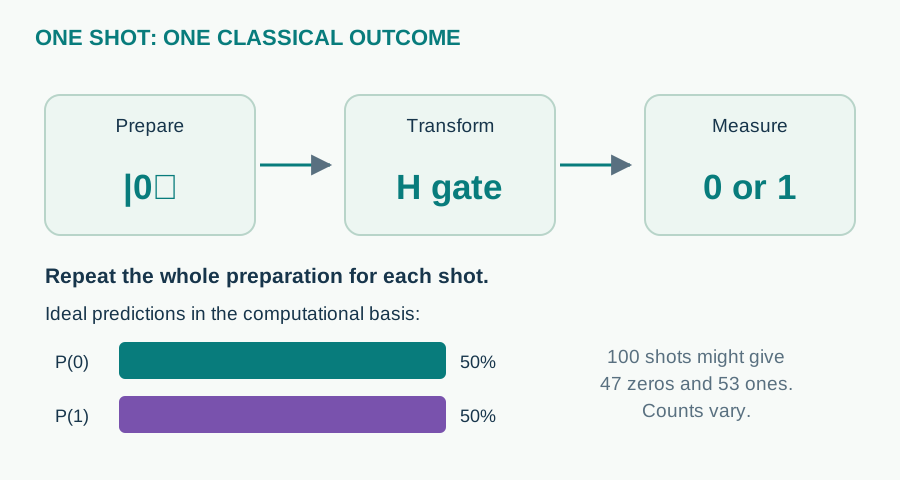
To estimate a preparation’s probabilities, prepare the state again for each trial, apply the same operations, and measure again. A complete trial is often called a shot. More shots usually improve statistical estimates, but a finite sample need not match the predicted percentages exactly. Repeating an inaccurate preparation many times can estimate its behaviour precisely without making it accurate. One measurement also cannot reveal arbitrary amplitudes; learning about a preparation generally requires many trials and appropriate measurement settings.
WORKED EXAMPLE
A classroom experiment with 200 fresh preparations
Imagine preparing |+⟩ from scratch 200 times and measuring each fresh qubit in the computational basis. The ideal expected counts are 100 zeros and 100 ones. An invented result of 107 zeros and 93 ones is compatible with ordinary sampling variation; it is not automatically evidence that the preparation is faulty.
The observed frequency of 0 is 107/200 = 53.5%. This is an estimate from those trials, not a replacement for the ideal prediction of 50%. Now suppose you instead prepare |+⟩ once, obtain 0, and immediately measure that same qubit 199 more times without changing it. In the ideal nondestructive model you obtain 0 every time. You have repeatedly checked a state already projected to |0⟩, not sampled 200 fresh plus states.
Common misconceptions
Misconception: One qubit lets me read both 0 and 1 at the same time.
What to remember: A computational-basis measurement returns one classical result. An algorithm must arrange useful measurement probabilities.
Misconception: A minus amplitude means a negative probability.
What to remember: Probabilities use squared magnitudes and are nonnegative. A minus sign can encode a relative phase that changes interference.
Misconception: Measuring one prepared qubit many times reveals its original superposition.
What to remember: Measurement changes the state. Independent trials require fresh preparation, and one measurement basis need not reveal all relevant features.
A small glossary
- Qubit
- A quantum information unit described using two reference states, |0⟩ and |1⟩.
- Amplitude
- A coefficient in a quantum state description; its squared magnitude gives an outcome probability in the chosen basis.
- Relative phase
- The phase difference between state contributions, which can affect interference.
- Measurement basis
- The set of distinguishable reference states used by a measurement.
- Shot
- One execution of a preparation and circuit, including its measurements.
Take these ideas with you
- A quantum state predicts measurement outcomes; it is not a list of answers available in one readout.
- The measurement basis and relative phase both matter.
- Estimate probabilities with repeated fresh preparations and allow for sampling variation.
Sources & further reading
Use these to explore the science behind this section. The explanations and teaching figures here are original.
- IBM Quantum Learning — Single systems: quantum information ↗
Technical reference for amplitudes, the Born rule, plus/minus states and relative phase.
- IBM Quantum Learning — Superposition with Qiskit ↗
Further exploration of interference and the limits of the coin analogy.
- IBM Quantum Learning — Bits, gates, and circuits ↗
Additional reference for ideal qubit states, circuits and measurement.
- IBM Quantum Learning — Build and run your first quantum program ↗
Practical context for repeated circuit executions, called shots; the original numerical example above is hypothetical.
Ready to check your understanding?
20 questions. Aim for 16 correct. You can revisit the lesson and retake the quiz.
Take the section quiz →