
By the end, you can…
- Predict simple X, H and controlled-NOT operations on the states introduced here.
- Trace a circuit that prepares the Bell state (|00⟩ + |11⟩)/√2.
- Distinguish matching measurement results from sufficient evidence of entanglement.
- Explain no-signalling and the scope of the no-cloning theorem.
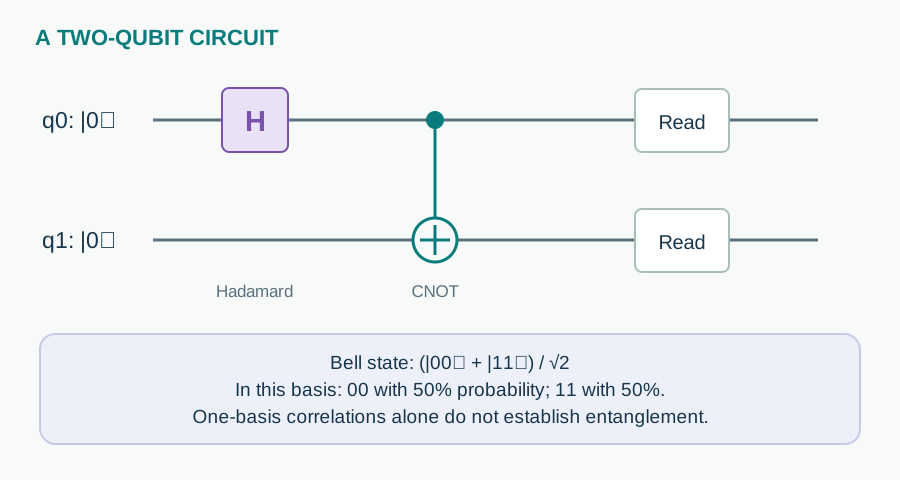
A circuit is a sequence of operations
A quantum circuit shows what to prepare, which operations to apply, and what to measure. We read its operations from left to right. A horizontal line follows a qubit through time; it does not mean an electrical wire physically carrying that qubit between boxes. A gate symbol represents a controlled operation. In the ideal model, the gates in this section are reversible: another suitable gate can undo them before measurement.
The X gate exchanges |0⟩ and |1⟩. Applied to |0⟩ it gives |1⟩; applied to |1⟩ it gives |0⟩. Applying X twice returns either state to its starting point. The Hadamard gate, written H, maps |0⟩ to |+⟩ and |1⟩ to |−⟩. It also maps |+⟩ back to |0⟩ and |−⟩ back to |1⟩. Therefore H followed immediately by H restores the original state in the ideal model. It is not equivalent to two independent coin tosses.
A controlled gate acts on two qubits
The controlled-NOT gate, or CNOT, has a control qubit and a target qubit. On computational-basis inputs, it flips the target exactly when the control is 1. For the notation in this lesson, the first digit is the control and the second is the target: |00⟩ stays |00⟩, |01⟩ stays |01⟩, |10⟩ becomes |11⟩, and |11⟩ becomes |10⟩. Other software may display bit strings in a different order, so always check its convention.
CNOT is a coherent operation, not an instruction to measure the control and then decide what to do. If the input contains a superposition, apply the same mapping to each term and retain their amplitudes. This is how a gate can produce entanglement. A computational-basis truth table is a useful first step, but tracking a superposition explains behaviour that the table alone does not show.
Create a Bell pair
Prepare two qubits in |00⟩. Apply H to the first, producing (|00⟩ + |10⟩)/√2. Then apply CNOT with the first qubit as control. The |00⟩ term stays put and the |10⟩ term becomes |11⟩. The result is (|00⟩ + |11⟩)/√2, often called the Bell state |Φ+⟩. A pair in this state is a Bell pair. This derivation describes an ideal circuit, not a claim that physical gates are flawless.
The pair has a joint state that cannot be expressed as a separate pure state for the first qubit multiplied by a separate pure state for the second. That is entanglement for this pure-state example. If both qubits are measured in the computational basis, 00 and 11 each occur with probability 1/2. Neither party can predict their individual result in advance, although their results agree when compared.
Correlations need careful interpretation
Agreement alone is not proof of entanglement. Two people could share a classical random bit and each write it down, producing the same 00/11 statistics. Distinguishing that classical mixture from the Bell pair requires additional, appropriate measurements. For example, applying H to both qubits before computational-basis measurement gives perfectly agreeing outcomes for the ideal |Φ+⟩ state. The 50/50 classical mixture of |00⟩ and |11⟩ instead gives all four outcomes equally often in that setting. Rigorous experimental verification must also account for noise and the assumptions of its test.
Entanglement does not send a chosen message by itself. If Alice and Bob share a Bell pair, Alice cannot choose which random measurement outcome she gets. Bob’s local outcome statistics do not reveal which local measurement Alice chose when her results are not communicated. They need an ordinary classical channel to compare their records or use measurement outcomes in a communication protocol. Entanglement therefore provides no faster-than-light messaging.
Why a quantum network cannot use an ordinary copy command
The no-cloning theorem rules out a universal physical operation that perfectly copies every arbitrary unknown quantum state while leaving the original intact. It does not forbid preparing a known state repeatedly. It also does not forbid copying a promised computational-basis value using CNOT and a target initially in |0⟩. The restriction concerns a copier that works for all possible input states.
To see the problem, try that CNOT copier with control |+⟩ and target |0⟩. It creates a Bell pair, not two independent |+⟩ states. Measuring both in the computational basis gives only 00 or 11; two independent plus states would also allow 01 and 10. Quantum communication must respect this difference. Later sections use entanglement and classical messages to transfer information without making a forbidden extra copy.
WORKED EXAMPLE
Predict the order of two gates
Start in |00⟩. Circuit A applies H to the first qubit, then CNOT with the first as control. It produces the Bell pair, so measuring both gives 00 or 11. Circuit B applies CNOT first, then H to the first qubit. The first gate does nothing to |00⟩; the final state is (|00⟩ + |10⟩)/√2.
Circuit B gives 00 or 10: its second qubit stays in |0⟩ and the pair is not entangled. The same gate names in a different order can implement a different computation. Before predicting an output, identify the input, gate order, control, target and measurement basis.
Common misconceptions
Misconception: Every CNOT creates entanglement.
What to remember: Whether it creates entanglement depends on its input. CNOT applied to |00⟩ leaves |00⟩ unchanged.
Misconception: Matching 00 and 11 outcomes prove a Bell pair.
What to remember: Classical shared randomness can produce the same statistics in one basis. Additional measurements are needed.
Misconception: No-cloning forbids making two qubits in any identical known state.
What to remember: Repeatedly preparing a specified state is allowed. A universal perfect copier for arbitrary unknown inputs is not.
A small glossary
- Gate
- A specified operation on one or more qubits; the ideal gates used here are reversible.
- CNOT
- A two-qubit gate that flips the target on basis inputs when its control is 1, extended coherently to superpositions.
- Entanglement
- Quantum correlations that cannot be represented as a mixture of independently specified local states; for a pure pair, its state cannot be factored into separate single-qubit states.
- Bell pair
- Two qubits sharing one of the maximally entangled two-qubit Bell states.
- No-signalling
- Local actions on one share of entanglement cannot alone communicate a chosen message to the other party.
Take these ideas with you
- Gate order, qubit order and measurement basis are part of a circuit’s meaning.
- A Bell pair is a shared quantum resource, and one matching histogram does not prove it was created.
- Neither faster-than-light signalling nor universal perfect cloning is enabled by entanglement.
Sources & further reading
Use these to explore the science behind this section. The explanations and teaching figures here are original.
- IBM Quantum Learning — Single systems: quantum information ↗
Definitions and action of X and H; the lesson’s circuit-order example is an original calculation.
- IBM Quantum Learning — Multiple systems: quantum information ↗
Joint states, controlled operations, entanglement and measurement of part of a system.
- IBM Quantum Learning — Limitations on quantum information ↗
The no-cloning theorem, its scope, and the distinction between relative and global phase.
- IBM Quantum Learning — Entanglement in action: introduction ↗
Distinguishes Bell-state entanglement from a classical distribution with matching computational-basis correlations.
- IBM Quantum Learning — Bell’s inequality with Qiskit ↗
Further study of how choices of measurement setting expose nonclassical correlations.
Ready to check your understanding?
20 questions. Aim for 16 correct. You can revisit the lesson and retake the quiz.
Take the section quiz →