
By the end, you can…
- Distinguish local gates from gates whose data qubits occupy different modules.
- Trace a teleport–compute–teleport-back strategy without writing code.
- Count its Bell-pair and classical-bit requirements without mistaking them for universal costs.
- Explain placement, scheduling, waiting time and communication overhead.
A circuit describes operations; a machine supplies locations
A circuit is an ordered set of operations on labelled qubits. Those labels describe the computation, but the hardware still needs a plan for where the quantum information lives. A placement assigns each data qubit to a module and to a physical carrier within it. That assignment may change while the circuit runs. The label a can continue to identify the same part of the computation even after teleportation moves its state to a different physical qubit.
A local gate uses qubits within one module. A remote gate must act on data initially held in different modules. An ordinary command sent over a classical network does not, by itself, perform a quantum interaction between those data qubits. A networked quantum implementation needs an appropriate physical connection or an entanglement-assisted protocol, together with local operations and coordination. Even local gates can need routing if a module does not support every desired direct interaction.
One deliberately simple way to perform a remote operation
Suppose module A holds data qubit a and module B holds data qubit b. We want a CNOT with a as control and b as target, with both output states finally back at their original modules. For this teaching strategy, assume ideal operations, available Bell pairs, and enough spare physical qubits to receive states and perform the local gate.
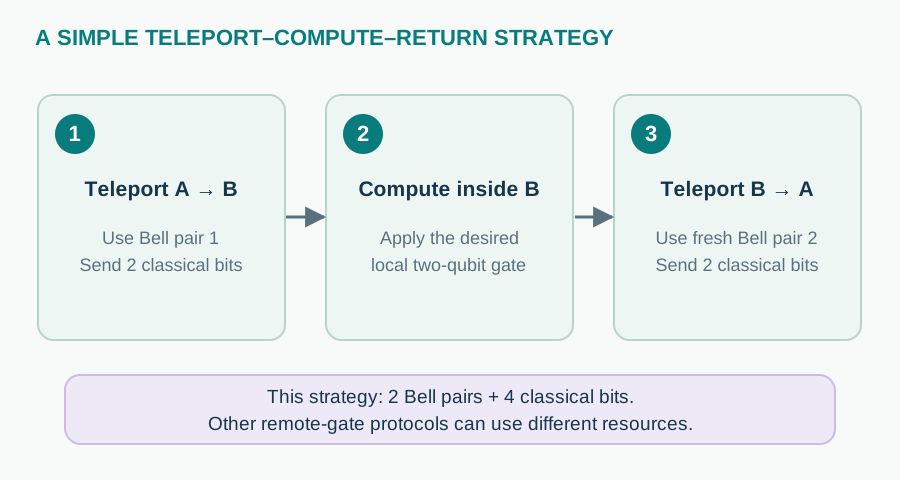
First teleport a's state from A to a receiving qubit at B, applying the corrections from section 4. Both pieces of quantum information are now at B. Apply the requested CNOT locally. Next teleport the part labelled a back to a receiving qubit at A, using a fresh Bell pair and new correction bits. The information labelled b remains at B. The two outputs may be entangled; ideal teleportation preserves that joint relationship.
This specific round-trip strategy consumes two Bell pairs and sends four teleportation correction bits: two on the outward transfer and two on the return. It also requires local gates, measurements, available storage and control messages. Two pairs and four bits are not a lower bound or a price for every remote gate. Gate-teleportation methods can implement operations without this entire round trip, and different architectures have different costs.
Placement can reduce avoidable travel
Imagine an original classroom circuit in which a interacts with b six times and with c once. If capacities and the rest of the circuit permit, placing a and b together may remove more remote interactions than placing a and c together. This is a useful first guess, not a proof of the best arrangement: gate order, spare qubits, link quality and other interactions can change the answer.
Returning a state after every gate is also not always necessary. If several consecutive operations involve the same destination module, a compiler may keep the state there for a while. That decision must respect the circuit's dependencies and eventual output requirements. We care about preserving the computation, rather than preserving each label's initial physical address after every step.
A scheduler turns the plan into a timeline
A scheduler chooses when to request entanglement, run local gates, perform measurements and use classical results. A dependent operation must wait until its required inputs or correction information are ready. Independent operations may run together if they have separate resources and the hardware supports it. Two requests cannot both use the same unavailable network qubit simply because they look independent on paper.
Some links create entanglement through repeated attempts. Waiting time therefore becomes part of the execution plan, and stored quantum information can suffer noise while it waits. Preparing resources in advance can help, but storing them for too long can reduce their quality. A good plan balances pair consumption, elapsed time, storage limits and accuracy. Fewer remote gates can be useful, yet that count alone does not determine the best schedule.
Judge the whole job
Communication overhead is the extra work introduced by cooperation: preparing resources, moving or linking information, waiting, exchanging classical results and handling failures. Compare complete execution plans for the same task and output-quality target. More modules may provide room for a larger circuit, but they do not automatically shorten its runtime. A cloud service that separately runs many unrelated quantum jobs is also different from modules jointly executing quantum operations across a network.
WORKED EXAMPLE
Two plans for three consecutive gates
In a hypothetical circuit, a starts at A and must take part in three consecutive two-qubit gates with b at B. Nothing else needs a at A during those gates, and a must return at the end. Assume all required local operations fit at B and every transfer uses the standard ideal protocol.
Plan 1 makes a round trip for each gate: three outward and three return transfers, consuming six Bell pairs and twelve correction bits. Plan 2 teleports a once to B, runs all three local gates in their required order, then teleports a back: two Bell pairs and four correction bits. Plan 2 saves four pairs and eight bits in this toy comparison. This resource saving alone does not establish a real machine's speed or fidelity; those require its timing and noise data.
Common misconceptions
Misconception: A remote gate always costs two Bell pairs.
What to remember: That is the cost of the round-trip strategy taught here. Other gate protocols and architectures have different requirements.
Misconception: Doubling the module count must halve the runtime.
What to remember: Dependencies, communication, resource limits and noise can prevent that speedup.
Misconception: The data qubit's circuit label must always refer to the same physical particle.
What to remember: A placement map tracks where the corresponding quantum information resides as the computation proceeds.
A small glossary
- Placement
- An assignment of a circuit's quantum information to modules and physical qubits.
- Remote gate
- An operation involving data held in different modules, implemented through a suitable connection or distributed protocol.
- Compiler
- A system that translates a circuit into operations and resource choices suitable for a particular machine.
- Scheduler
- The part of an execution plan that selects when operations occur while respecting dependencies and resource availability.
- Communication overhead
- The extra resources, operations and time needed for modules to cooperate.
Take these ideas with you
- Distributed execution needs both a location plan and a timing plan.
- For our specific teleport–compute–teleport-back strategy, budget two Bell pairs and four correction bits.
- Compare complete task cost and output quality; module count alone does not predict speedup.
Sources & further reading
Use these to explore the science behind this section. The explanations and teaching figures here are original.
- Cuomo et al. — Optimized compiler for Distributed Quantum Computing ↗
Research on remote-gate compilation, entanglement distribution, local operations and classical communication.
- A Modular Quantum Compilation Framework for Distributed Quantum Computing ↗
Research on circuit partitioning and scheduling remote operations to manage entangled-pair consumption.
- Compiler for Distributed Quantum Computing: a Reinforcement Learning Approach ↗
Research considering execution time, probabilistic entanglement generation, routing and scheduling together.
- IBM Quantum Learning — Quantum teleportation ↗
Basis for the standard transfers used in the original round-trip example. The example's resource counts are derived in the lesson, not reported benchmark results.
Ready to check your understanding?
20 questions. Aim for 16 correct. You can revisit the lesson and retake the quiz.
Take the section quiz →