
By the end, you can…
- Distinguish separate quantum jobs from a coherent computation across modules.
- Identify the roles of local gates, network qubits, stored data and classical control.
- Describe heralded entanglement generation without assuming every attempt succeeds.
- Read a network schematic without confusing logical connectivity with a direct physical link.
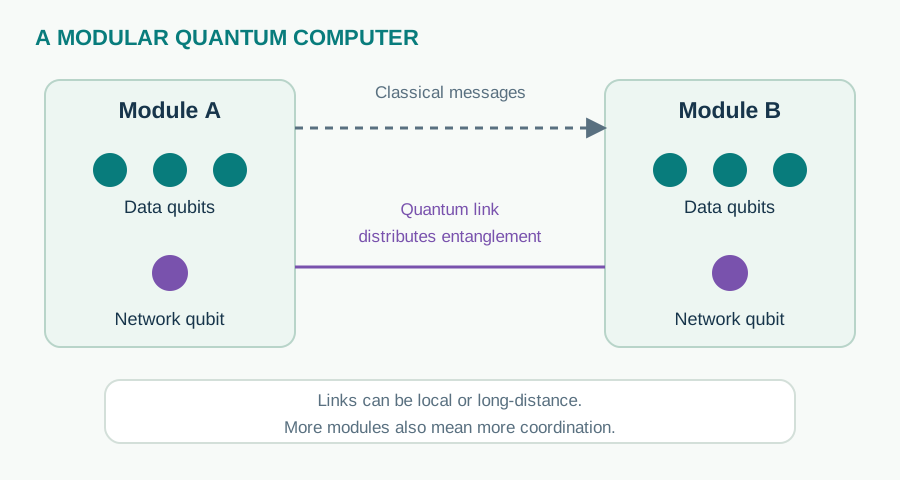
What is being distributed?
An ordinary distributed computer divides work among machines and exchanges classical data. Quantum processors can also run separate jobs and send measured results to a classical coordinator. That is useful, but it does not by itself create one larger coherent quantum processor. In this course, distributed quantum computing means a computation whose quantum information and operations span connected modules, using quantum communication or shared entanglement as well as classical coordination.
A module is a local quantum processing unit with qubits and control hardware. Several small modules may be easier to build and control than a single much larger device, motivating modular designs. However, adding modules also adds interfaces, scheduling and communication costs. Two modules do not automatically run a task twice as fast, and a larger physical qubit count does not by itself establish a useful computing advantage.
The two kinds of connection
A quantum link supports transmission of quantum information or the establishment of entanglement between nodes. In optical implementations, photons interact with matter qubits and travel through fibre or free space. Optical loss means some photons never reach their destination. A classical link carries ordinary information such as timing instructions, detector reports, measurement outcomes and acknowledgements. Both kinds of connection are needed in the entanglement-assisted protocols covered here.
The two links describe functions, not necessarily two visibly separate cables. A drawing may show a coloured line for the quantum channel and a dashed line for classical communication. That legend tells you what the lines mean; it does not tell you the distance, error rate or hardware layout. The mere presence of fibre is not enough to make an ordinary network quantum: the devices and protocols must use it to support quantum information.
Different qubits can have different jobs
Data qubits, also called circuit qubits in some architectures, hold the quantum information used in a computation. Network qubits provide an interface to a link and help establish entanglement with another module. Local operations connect these roles, allowing a shared network resource to support work on the data. A quantum memory preserves a quantum state while other operations or communication take place; storing a measured bit in a file is a different task.
These are roles, not universal species of qubit. Some implementations use different physical systems for communication and storage; others reuse qubits or move states between available resources. A simplified drawing with one data qubit and one network qubit per module explains the roles without specifying a complete machine. Real systems also need readout, calibration, control electronics and often additional qubits.
A herald announces a useful event
In one common optical approach, each module couples a network qubit to emitted light. The light is combined and measured using an appropriate optical arrangement. A selected detector pattern announces that the protocol has generated remote entanglement, subject to its imperfections. This classical success announcement is a herald. It does not reveal the stored computational state, and it does not mean that every entanglement attempt succeeds.
A controller may repeat unsuccessful attempts, record a herald, and make the resulting pair available to a later operation. Network attempts should be designed so that they do not erase the computation being stored elsewhere. Even a successful herald does not guarantee a perfect Bell pair: errors and unwanted detector events can reduce its quality. Memory is also imperfect, so the time spent waiting matters. Link generation, storage and computation therefore have to be planned together.
Read topology as a set of available connections
A network’s topology describes how its nodes are connected. A chain A—B—C has two direct links: A to B and B to C. A star connects several outer nodes to a central one. Other arrangements provide more direct paths, at the cost of additional resources. A line in a schematic is an available connection, not a promise that an entangled pair is always waiting on it.
Nodes without a direct link may still share entanglement through suitable intermediate protocols. That capability needs resources and takes time. It does not turn a chain into three direct physical links or make remote gates identical in cost to local gates. When assessing a design, ask which operations are local, which need the network, what must wait in memory, and which classical messages must arrive first.
WORKED EXAMPLE
Two desks, one joint quantum task
Imagine module Cedar holding data qubit c and network qubit nC, while module Maple holds data qubit m and network qubit nM. A requested circuit includes an operation involving c and m. A classical message containing a measurement of c would generally destroy information needed for that coherent operation, so simply emailing a measured value is not an equivalent replacement.
Instead, a possible plan first generates an entangled pair on nC and nM. The controllers receive a success herald. They then use an appropriate protocol with local operations, measurements and classical messages to implement the required remote operation. During preparation of that resource, c and m must retain their useful quantum information. This is a conceptual example, not a claim about any particular device’s speed or success rate.
For a concrete research reference, Main and colleagues reported a 2025 experiment using two trapped-ion modules connected by an optical link. The modules had separate network and circuit-qubit roles, and used shared entanglement plus classical communication for gates between modules. It demonstrates the approach in a small experiment; it does not establish that large distributed quantum computers are already generally faster or error-free.
Common misconceptions
Misconception: Running unrelated jobs on two quantum processors creates a joint entangled computer.
What to remember: Sharing classical results does not by itself provide coherent operations between their qubits.
Misconception: A herald means the link is perfect and will always succeed.
What to remember: It reports a protocol-defined successful event. Generation may be probabilistic, and the resulting pair can still have errors.
Misconception: All-to-all logical connectivity means every pair of qubits has a direct physical cable.
What to remember: Protocols can provide effective remote interactions over a network with different physical connectivity and additional resource costs.
A small glossary
- Module
- A local quantum processor or processing unit connected to other such units.
- Network qubit
- A qubit used as an interface for quantum communication or remote entanglement generation.
- Quantum memory
- A system or operation that preserves quantum information for later use, with a finite storage quality and lifetime.
- Herald
- A classical signal indicating a selected success event in a quantum protocol.
- Topology
- The arrangement of nodes and their direct connections in a network.
Take these ideas with you
- A joint distributed quantum computation needs suitable quantum resources and classical coordination.
- Data storage and network generation have different roles and must be coordinated.
- A schematic shows relationships; it does not establish performance, fidelity or direct connectivity for every pair.
Sources & further reading
Use these to explore the science behind this section. The explanations and teaching figures here are original.
- Main et al. — Distributed quantum computing across an optical network link (Nature, 2025) ↗
Primary experiment supporting network/circuit-qubit roles, optical entanglement and classical coordination; no experimental figure is reproduced.
- Dahlberg et al. — A Link Layer Protocol for Quantum Networks ↗
Primary protocol work on turning heralded entanglement generation into a controlled network service.
- Humphreys et al. — Deterministic delivery of remote entanglement on a quantum network ↗
Primary work on coordinating entanglement generation and storage; useful distinction between generation attempts and delivery of a resource.
- Kalb et al. — Entanglement Distillation between Solid-State Quantum Network Nodes ↗
Primary experimental reference for communication and storage roles at network nodes, and for imperfect remote entanglement.
Ready to check your understanding?
20 questions. Aim for 16 correct. You can revisit the lesson and retake the quiz.
Take the section quiz →